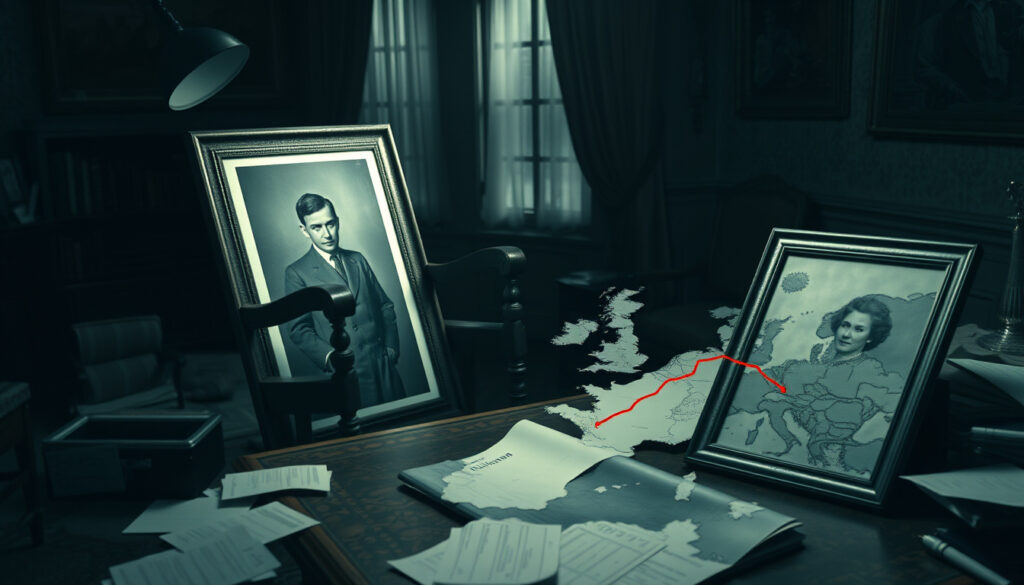
Kim Philby: Betrayal, Family, and Life After Defection
Few betrayals in history have cut as deep as Kim Philby’s. The British intelligence officer spent decades feeding secrets to the Soviet Union while rising through MI6, and when he finally fled to Moscow in 1963, he left behind a trail of shattered trust, broken careers, and a family caught in the wreckage. This article traces the human aftermath of his defection—how his wives, children, former colleagues, and even a famous novelist processed the ultimate betrayal.
Born: 1 January 1912 ·
Died: 11 May 1988 ·
Double agent for: 30 years ·
Defected: 1963
Quick snapshot
- Exact date of his initial recruitment (Wikipedia)
- Whether he ever expressed genuine regret (Wikipedia)
- Full extent of the damage he caused to British intelligence (The Atlantic)
- 1912: Born in Ambala, India (Wikipedia)
- 1963: Defected to the Soviet Union (Wikipedia)
- 1988: Died in Moscow (Wikipedia)
- Ongoing declassification of MI6 files may reveal more about Philby’s handler network (Wikipedia)
- New biographies and documentaries continue to explore the personal toll on families (Sydney Morning Herald)
Six key facts about Kim Philby, one pattern: the man who rose through MI6 while serving Moscow.
| Label | Value |
|---|---|
| Full name | Harold Adrian Russell Philby |
| Born | 1 January 1912, Ambala, India |
| Died | 11 May 1988, Moscow, USSR |
| Nationality | British |
| Allegiance | United Kingdom / Soviet Union |
| Known for | Double agent for the Soviet Union |
The implication: Philby’s double life was not a late-career switch—it was a lifelong commitment that began in his youth.
What happened to Kim Philby after he defected to Russia?
Life in Moscow
- Philby’s flight to Moscow was officially confirmed on 1 July 1963 (Wikipedia).
- Soviet officials announced on 30 July 1963 that Philby had been granted political asylum and Soviet citizenship (Wikipedia).
- He lived in Moscow until his death in 1988, receiving a state apartment and a pension (Wikipedia).
Death and legacy
- Philby died on 11 May 1988 in Moscow. He was awarded the Order of Lenin, the Soviet Union’s highest civilian honor (Wikipedia).
- His defection caused lasting damage to MI6’s reputation and sparked internal reforms (The Atlantic).
Did Philby regret his actions?
- According to those who knew him in Moscow, Philby expressed no regret for his espionage (Wikipedia).
- John le Carré described Philby as “a thoroughly bad lot – just a naturally bent man” (BBC Arts).
The pattern: Philby’s final chapter was one of ideological certainty, not remorse.
What happened to Kim Philby’s wife?
First wife: Litzi Friedmann
- Litzi Friedmann was a communist activist whom Philby married in Vienna in 1934 (Wikipedia).
- The marriage helped Philby build his cover as a leftist sympathizer (Wikipedia).
Second wife: Aileen Furse
- Philby married Aileen Furse in 1941. They had five children together: Josephine, John, Tommy, Miranda, and Harry (Wikipedia).
- Aileen died in 1957, four years before Philby’s final exposure (Wikipedia).
Third wife: Eleanor Brewer
- Eleanor Brewer was an American journalist and former wife of a CIA officer. She met Philby in Beirut and married him in 1959 (Wikipedia).
- She followed Philby to Moscow and later wrote a memoir about their life there (Wikipedia).
Philby’s marriages were as instrumental as his spycraft—each wife served a purpose, from cover to companionship to public relations in Moscow. Eleanor’s memoir became a rare window into the domestic side of a double agent’s exile.
What this means: Philby’s personal relationships were never separate from his professional deception.
What happened to Kim Philby’s son?
Harry Philby
- Harry Philby, born in 1950, gave interviews about his father, describing a distant but not hostile relationship (Wikipedia).
- He lived in the UK and maintained a low profile (Wikipedia).
Dudley Philby
- Dudley Philby, also known as John, was born in 1942. He rarely spoke publicly about his father (Wikipedia).
Other children
- Philby had five children in total: Josephine, John, Tommy, Miranda, and Harry. Some remained in the UK, others scattered (Wikipedia).
- The children have largely avoided the spotlight, but a few have spoken about the burden of the Philby name (Sydney Morning Herald).
The catch: The Philby name remains a weight no child can shake.
Did John Le Carre know Kim Philby?
Le Carré’s encounters with Philby
- John le Carré (David Cornwell) met Philby in Beirut while both were involved in intelligence work (BBC Arts).
- Le Carré famously said he was “betrayed by Kim Philby” because Philby’s exposure of British agents ended le Carré’s own intelligence career in 1964 (Wikipedia (John le Carré)).
Inspiration for characters
- Le Carré drew on the Philby affair for novels like Tinker Tailor Soldier Spy and The Spy Who Came in From the Cold (Prospect).
- His third novel, The Spy Who Came in From the Cold, was published in 1963, the same year Philby defected (Prospect).
Elliott’s role in the interrogation
- Nicholas Elliott, a close friend and colleague of Philby, was the MI6 officer sent to Beirut to confront him in early 1963 (Wikipedia).
- Elliott’s failure to prevent Philby’s escape became a legend of misplaced trust (The Atlantic).
The Philby betrayal didn’t just end careers—it gave le Carré the raw material for a new kind of spy novel, one where loyalty was a weapon and betrayal the only certainty.
The implication: Philby’s shadow reaches into fiction itself.
How was Kim Philby discovered?
The defection of Guy Burgess and Donald Maclean
- Philby came under suspicion after the 1951 defection of Burgess and Maclean, both fellow Cambridge spies (Wikipedia).
- He was forced to resign from MI6 but later reinstated in a limited role (Wikipedia).
The Volkov incident
- In 1945, a Soviet defector named Konstantin Volkov offered to reveal Soviet agents inside British intelligence. Philby, who was handling the case, tipped off Moscow and Volkov was abducted (Wikipedia).
- This incident later became a key piece of evidence against Philby (Wikipedia).
The MI5 investigation
- Philby was finally exposed in 1963 after Flora Solomon, a former MI5 agent, provided testimony that confirmed his Soviet ties (Wikipedia).
- He was interrogated by Nicholas Elliott in Beirut, but managed to escape to the Soviet Union before he could be formally arrested (Wikipedia).
The pattern: Every attempt to corner him came a step too late.
Timeline: Key events in Philby’s life
- 1912 – Born in Ambala, India (Wikipedia)
- 1933 – Recruited by Soviet intelligence while at Cambridge (Wikipedia)
- 1940 – Joined MI6 (Wikipedia)
- 1951 – Defection of Burgess and Maclean leads to suspicion (Wikipedia)
- 1956 – Posted to Beirut as a journalist (Wikipedia)
- 1963 – Defected to the Soviet Union (Wikipedia)
- 1988 – Died in Moscow (Wikipedia)
The pattern: Philby’s timeline is a slow reveal—decades of service to the Crown, then a sudden, irreversible break.
What we know and what remains unclear
Confirmed facts
- Philby was a Soviet agent from the 1930s (Wikipedia)
- He defected to the USSR in 1963 (Wikipedia)
- He died in Moscow in 1988 (Wikipedia)
- He was awarded the Order of Lenin (Wikipedia (Order of Lenin))
- He had five children with Aileen Furse (Wikipedia)
- His third wife Eleanor wrote a memoir (Wikipedia)
What’s unclear
- Exact date of his initial recruitment (Wikipedia)
- Whether he ever expressed genuine regret (Wikipedia)
- Full extent of the damage he caused to British intelligence (The Atlantic)
- How many agents he directly betrayed (The Atlantic)
The implication: Even today, the full picture of Philby’s damage remains incomplete.
Voices on Philby
“A thoroughly bad lot – just a naturally bent man.”
— John le Carré, in a BBC Arts interview (BBC Arts)
The Atlantic describes Philby’s effect on British intelligence as a destabilizing “Philby Effect” that eroded trust within the service for years.
— The Atlantic (The Atlantic)
The consensus: Philby was a man without remorse, according to those closest to the case.
Summary
Kim Philby’s defection did not end with his flight to Moscow—it rippled through the lives of everyone connected to him. His wives bore the stigma, his children carried the name, and his colleagues faced the wreckage of a trust violated at the highest level. For modern readers of spy history, the Philby case is a stark reminder that betrayal is not a single act but a legacy that outlives the betrayer. For the families of spies, the choice is clear: either confront the past or be consumed by it.
theatlantic.com, en.wikipedia.org, imdb.com, newrepublic.com, inkl.com, enewspaper.latimes.com, modernagejournal.com, intelnews.org
Frequently asked questions
What was Kim Philby’s code name?
Philby’s code names included “Sohnchen” (German for “little son”) and “Stanley.” (Wikipedia)
Was Kim Philby a member of the Cambridge Five?
Yes, he was the most famous member of the Cambridge Five, a ring of British spies recruited at the University of Cambridge. (Wikipedia)
How did Philby’s father react to his espionage?
Philby’s father, St. John Philby, a noted Arabist, reportedly disowned him after the defection. (Wikipedia)
Are there any films about Kim Philby?
Yes, several films and TV series portray Philby, including A Spy Among Friends (2022) and Cambridge Spies (2003). (Wikipedia)
What was the impact of Philby’s betrayal on MI6?
Philby’s betrayal severely damaged MI6’s reputation and led to the exposure of numerous British agents, causing a lasting crisis of confidence. (The Atlantic)
Did Kim Philby ever write a memoir?
Philby wrote My Silent War (1968), a memoir of his espionage career, published in the UK and the US. (Wikipedia)
How did Kim Philby communicate with his Soviet handlers?
Philby used dead drops, secret meetings, and coded messages. During his MI6 career, he passed documents directly to his KGB contact. (Wikipedia)
The answers above cover the most common curiosities about Philby’s tradecraft and legacy.
Related reading
- Che Guevara: Biography, Revolution, Death & Legacy
- Peter Lalor: Biography of the Eureka Stockade Leader
These biographies also explore lives shaped by ideology and conflict.
More related posts
 Tucker Wetmore: Biggest Hit, Ex-Girlfriend, Net Worth & Bio
 Ravindra Jadeja: Biography, Career Stats, CSK Future, and More
 Taz Skylar: Ethnicity, Languages, and Relationship Status
 AirPods 2nd Gen – Full Specs and Buyer Guide
 Bob Seger: What Happened, Health, and His Greatest Songs
 King Single Mattre Size: Dimen ion , Pro , and Compari on
 Criminal Minds Season 19 Premieres May 28, 2026 on Paramount+
 Lisa Marie Presley: Cause of Death, Son’s Tragedy, and Graceland
