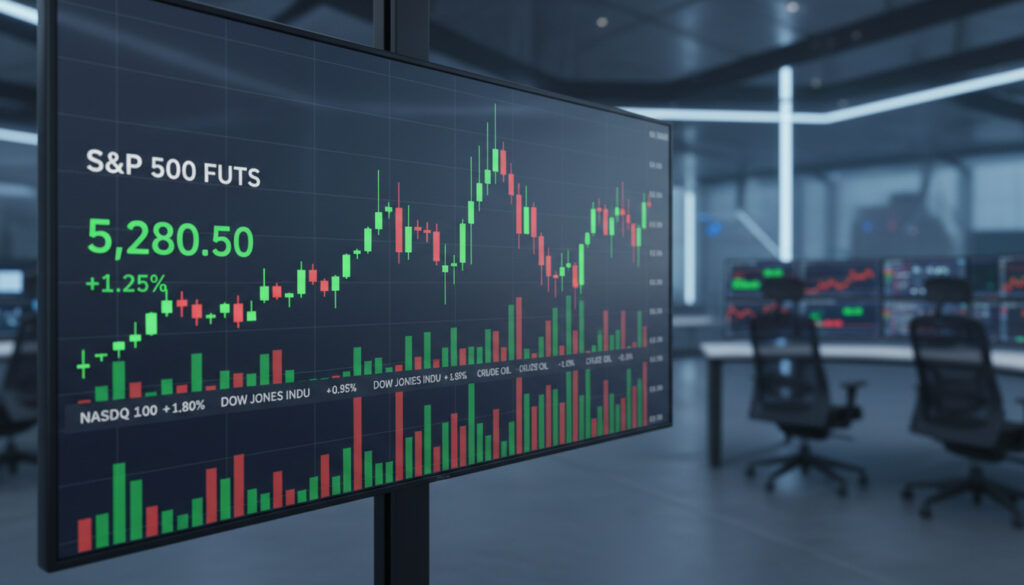
S&P 500 Futures – Current Price Chart Trading Guide
E-mini S&P 500 futures track the broad U.S. equity market nearly around the clock, offering traders exposure to the S&P 500 Index through standardized contracts traded on CME Globex. Current pricing data shows the benchmark ES contract fluctuating between 6,641 and 6,654 USD, with session-to-session changes ranging from -0.15% to +0.66% over recent 24-hour periods.
These derivatives serve both institutional hedgers and individual speculators, providing a leveraged mechanism to position for macroeconomic trends without direct stock ownership. The instruments maintain deep liquidity, with recent sessions showing substantial volume alongside tight bid-ask spreads that facilitate execution at nearly any hour.
What Are S&P 500 Futures?
S&P 500 futures represent legally binding agreements to buy or sell the cash value of the S&P 500 Index at a predetermined future date. Unlike purchasing individual stocks, these contracts derive their value from the aggregate performance of 500 large-cap U.S. companies, allowing market participants to speculate on or hedge against broad market movements.
6,641.25 USD
-0.15% to +0.66%
13,982 contracts
4,832.00 – 6,502.50
- Contracts trade nearly 24 hours daily, bridging Asian, European, and U.S. market sessions.
- Standard ES contracts carry a $50 multiplier per index point, while Micro E-mini (MES) contracts use a $5 multiplier.
- Liquidity significantly exceeds that of comparable ETFs, with NinjaTrader data suggesting approximately 8 times the liquidity of S&P 500 ETFs.
- Tax treatment differs from stocks, with futures potentially qualifying for Section 1256 benefits.
- No management fees apply, though brokerage commissions and exchange fees remain.
- Day trading margins often require less capital than holding equivalent stock positions overnight.
- Price discovery occurs continuously, reflecting global sentiment outside standard U.S. equity hours.
| Specification | Standard E-mini (ES) | Micro E-mini (MES) |
|---|---|---|
| Symbol | ES | MES |
| Exchange | CME Globex | CME Globex |
| Point Value | $50 USD per index point | $5 USD per index point |
| Minimum Tick | 0.25 index points ($12.50) | 0.25 index points ($1.25) |
| Trading Hours | Sun 6:00 pm – Fri 5:00 pm ET | Sun 6:00 pm – Fri 5:00 pm ET |
| Contract Unit | $50 x S&P 500 Index | $5 x S&P 500 Index |
| Settlement | Cash settlement | Cash settlement |
| Tick Size | 0.25 | 0.25 |
| Margin Requirement | Higher | Lower (1/10th of ES) |
| Liquidity | Extremely High | High |
| Primary Use | Institutional/Active Trading | Retail/Position Scaling |
Current S&P 500 Futures Price and Status
Real-time quotes display delayed and live data streams across multiple platforms. As of recent timestamps (06 Apr 2026 07:14:45 UTC), Investing.com listed ES futures at 6,465.75 (-0.35%), while alternative feeds showed 6,654.75 (+0.66%) over 24-hour periods, illustrating the volatility inherent in overnight sessions.
Live Chart Access
TradingView and Investing.com provide streaming charts with candlestick, line, bar, and Heikin Ashi visualization options. These interfaces support technical indicator overlays and historical comparisons, though data delays vary by platform—some feeds exhibit 10-minute delays while others offer real-time tick data through direct exchange connections.
Market Sentiment Indicators
Client positioning data from IG showed a near-even split at 51% long versus 49% short among retail participants, suggesting conflicting expectations about near-term directional momentum. This distribution reflects uncertainty surrounding upcoming economic releases and Federal Reserve policy trajectories.
Charting platforms may display different timestamps depending on their exchange agreements. CME Globex direct feeds provide real-time data, while public websites often impose 10-15 minute delays. Traders executing live orders should verify their broker’s data latency to avoid pricing discrepancies.
S&P 500 Futures Trading Hours
The CME Globex platform maintains continuous trading from Sunday at 6:00 pm Eastern Time through Friday at 5:00 pm ET, with daily maintenance breaks typically occurring between 5:00 pm and 6:00 pm ET Monday through Thursday. This schedule accommodates hedging activities across Asian and European market opens when U.S. equity markets remain closed.
Overnight sessions often exhibit reduced liquidity compared to the U.S. cash market overlap (9:30 am – 4:00 pm ET), resulting in wider spreads and increased volatility. Economic releases scheduled outside standard hours—such as international manufacturing data or geopolitical developments—frequently trigger immediate price reactions in these extended sessions.
How to Trade S&P 500 Futures
Access requires a futures brokerage account with permissions for CME Globex products. NinjaTrader and similar platforms offer direct market access with analytical tools, though traders must meet margin requirements and understand leverage risks before execution.
Contract Selection Strategy
Beginners often initiate positions using Micro E-mini (MES) contracts due to the reduced $5-per-point multiplier, allowing finer position sizing with limited capital. Standard ES contracts suit larger accounts or hedging strategies requiring substantial notional exposure per trade.
A one-point move in the S&P 500 Index equals $50 on ES contracts versus $5 on MES contracts. Traders controlling equivalent notional exposure require approximately one-tenth the margin capital with MES, though commission costs per dollar of exposure increase proportionally.
Futures trading involves substantial risk of loss due to leverage. A 20-point adverse move in the S&P 500 generates a $1,000 loss on a single ES contract—losses that can exceed initial margin deposits. Traders should implement stop-loss mechanisms and maintain excess capital beyond minimum margin requirements.
Execution Platforms
Electronic trading dominates the ecosystem, with participants utilizing desktop applications, web interfaces, or API connections for algorithmic strategies. CME Group’s official platforms provide benchmark pricing, while third-party vendors offer advanced charting and automated trading capabilities.
S&P 500 Futures Contract Specifications
Standardized terms ensure fungibility across the global marketplace. The ES contract represents $50 multiplied by the S&P 500 Index value, with minimum price increments of 0.25 index points translating to $12.50 per tick. Cash settlement occurs quarterly, eliminating physical delivery requirements.
Micro contracts (MES) maintain identical tick sizes (0.25 points) but reduce financial impact to $1.25 per minimum fluctuation, enabling precise risk management for smaller accounts. Both varieties trade on CME Globex with identical hourly schedules and settlement procedures.
Historical Timeline of S&P 500 Futures
- : CME launches the first S&P 500 futures contract, revolutionizing index speculation and institutional hedging capabilities.
- : E-mini S&P 500 futures debut, reducing contract sizes to attract electronic traders and smaller institutions.
- : Micro E-mini contracts (1/10th size) launch, democratizing access for retail participants with limited capital.
- : Volume spikes during pandemic volatility establish new liquidity records as hedging demand surges.
- : Price appreciation drives notional values above 6,500 index levels, with 52-week ranges expanding to 4,832–6,502.
Established Facts and Information Gaps
Verified Data
- Contract symbols: ES and MES on CME Globex
- Trading hours: Sunday 6:00 pm ET through Friday 5:00 pm ET
- Point values: $50 (ES) and $5 (MES)
- Current price ranges: 6,400–6,650 USD zone
- Tax advantages: Potential Section 1256 treatment
- Liquidity: Higher than comparable ETFs
Uncertain or Variable
- Specific open interest figures remain unavailable in current data feeds
- Exact margin requirements vary by broker and regulatory changes
- Future price direction depends on unresolved economic factors
- Overnight volume statistics fluctuate significantly session-to-session
- Retail sentiment percentages shift intraday
Context and Market Significance
S&P 500 futures function as the primary price discovery mechanism for U.S. equity markets during non-trading hours. Global portfolio managers utilize these contracts to adjust exposure ahead of market opens, while domestic traders hedge existing stock positions against overnight risk. The iPhone 16 Pro Price fluctuations in tech sectors often correlate with index futures movements, illustrating how individual component stocks influence the broader benchmark.
Tax efficiency attracts high-frequency participants, as futures potentially qualify for blended 60/40 long-term/short-term capital gains treatment under U.S. tax code Section 1256. This structure contrasts with stock trading, where holding periods determine tax rates entirely. The instruments also facilitate sector rotation strategies without incurring the transaction costs of liquidating and reconstituting broad equity portfolios.
Data Sources and Market Perspectives
“E-mini S&P 500 futures provide nearly 24-hour exposure to the S&P 500 Index with high liquidity, allowing traders to speculate or hedge on U.S. market movements outside regular stock market hours.”
— NinjaTrader, Futures Contract Documentation
“Advanced charts support candlesticks, lines, bars, Heikin Ashi, technical indicators, and comparisons, powered by TradingView.”
— Investing.com, Charting Platform Specifications
Key Takeaways on S&P 500 Futures
S&P 500 futures offer continuous exposure to U.S. large-cap equities through standardized CME Globex contracts available in standard (ES) and micro (MES) sizes. Current pricing hovers near 6,641 USD with trading available nearly around the clock from Sunday evening through Friday afternoon. While specifications and historical performance data remain transparent through official exchange channels, specific open interest figures and precise future valuations remain subject to market forces. Traders seeking complementary technology pricing data may reference the AirPods 2nd Gen – Full Specs and Buyer Guide for consumer electronics market context.
Common Questions About S&P 500 Futures
Are S&P 500 futures trading right now?
CME Globex operates from Sunday 6:00 pm ET through Friday 5:00 pm ET, with brief daily maintenance breaks. Check current timestamps against this schedule to determine active trading status.
What is the exact symbol for E-mini S&P 500 futures?
The standard contract trades under the symbol ES, while the micro version uses MES. Both symbols execute exclusively on CME Globex.
How do S&P 500 futures differ from the SPY ETF?
Futures involve leverage, nearly 24-hour trading, and potential tax advantages under Section 1256. ETFs involve no expiration dates but incur management fees and offer no overnight exposure.
Where can I access historical S&P 500 futures data?
CME Group provides official historical quotes, while Investing.com and TradingView offer downloadable chart data spanning multiple years including 52-week ranges of 4,832–6,502.50.
What is the minimum capital required to trade?
Intraday margins vary by broker but often range from $500–$1,000 per ES contract. Micro contracts require approximately one-tenth that amount, though traders should maintain excess capital for volatility buffers.
How are S&P 500 futures taxed compared to stocks?
Qualified futures contracts may receive 60/40 tax treatment—60% long-term capital gains rates and 40% short-term—regardless of holding period, unlike stocks where duration determines the rate.
Why do futures prices differ from the spot S&P 500 index?
Futures incorporate interest rates, dividend expectations, and time decay through a cost-of-carry calculation. Overnight news also shifts futures while cash markets remain closed.
More related posts
 Jimmy Butler ACL Injury: Recovery Timeline and Trade Rumors
 How to Get, Install, and Use Apple CarPlay (Complete Guide)
 Shangri-La Singapore vs Rasa Sentosa: Key Differences
 Google Drive Login – Sign In Guide for All Devices
 Kim Cattrall: Feud, Tragedy, and Decision to Not Have Children
 Is Henry Sugar Real? Fact vs Fiction Explained
 Howard Lutnick: 9/11, Billionaire, Trump Commerce Secretary
