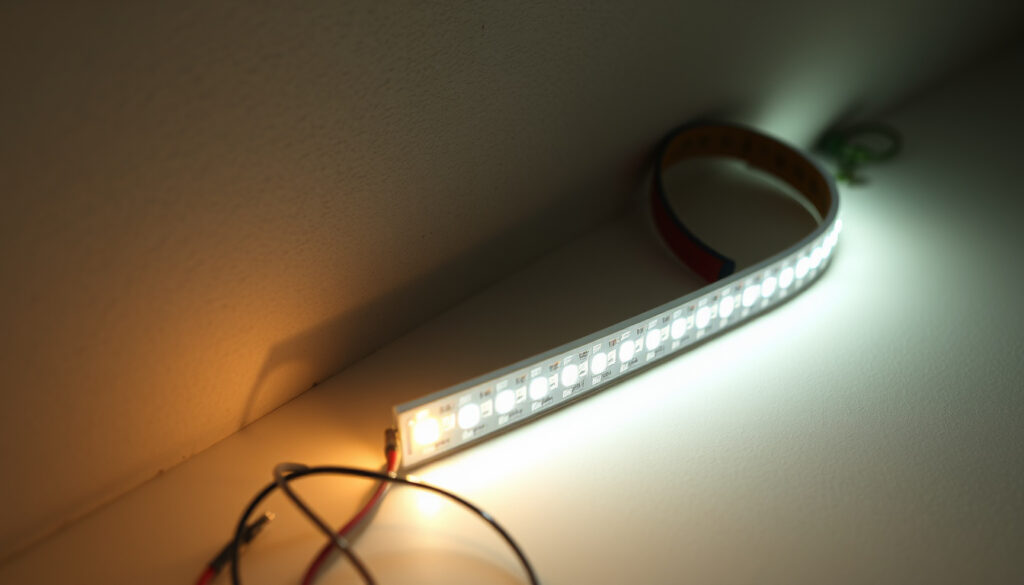
LED Strip Lights: Installation, Legality, and Common Mistakes
There’s something oddly satisfying about the glow of a well-placed LED strip—until it flickers, dims halfway, or refuses to stick, as anyone who’s wrestled with a tangle of copper pads and adhesive backing already knows. This guide walks through the common pitfalls, legal quirks in Ireland, and the practical steps to get your strips glowing right the first time.
Energy savings: Up to 80% less energy than incandescent ·
Average lifespan: 50,000 hours ·
Voltage options: 12V or 24V ·
Common length: 5m or 10m rolls
Quick snapshot
- LED strip lights require a 12V or 24V power supply (Flexfire LEDs (LED manufacturer))
- Voltage drop causes inconsistent brightness over long runs (HitLights (lighting component supplier))
- Heat dissipation must be considered when strips are encased (LED Lighthouse (UK lighting retailer))
- Exact building-code requirements for outdoor LED strips in Ireland (PacLights (commercial lighting manufacturer))
- Whether professional installation is legally mandated in all countries (LED Lighthouse (UK lighting retailer))
- Typical troubleshooting starts with a visual check of connectors and solder joints (HitLights (lighting component supplier))
- Always verify your dimmer is LED-compatible to avoid flickering (LED Lighthouse (UK lighting retailer))
Six installation factors, one pattern: most problems trace back to the same three mistakes.
| Factor | Detail |
|---|---|
| Voltage options | 12V or 24V (Flexfire LEDs) |
| Power supply needed | Yes, requires a driver or battery (Flexfire LEDs) |
| Maximum run before voltage drop | Typically 5–10 m (HitLights) |
| Driver load recommendation | Use only 80% of rated wattage (Flexfire LEDs) |
| Heat management | Aluminum channel improves dissipation (LED Lighthouse) |
| Surface prep | Clean, dry surface required for adhesive backing (LED Lighthouse) |
What are the disadvantages of LED light strips?
LED strips are versatile but come with trade-offs. The most common complaints—flickering, uneven brightness, and early failure—stem from a handful of technical limits. HitLights notes that voltage drop is the leading cause of a dim tail end on runs over 5 m. Heat buildup is another issue: when strips are enclosed without an aluminum channel, the adhesive can weaken and the LEDs degrade faster (LED Lighthouse).
Do all LED strip lights have to be plugged in?
- Nearly all consumer LED strips require a constant power source—a wall plug or a direct connection to a 12V/24V driver. They are not self-powered. PacLights emphasises that the power source must be correctly rated for the strip’s wattage to avoid overloading the circuit.
What happens if you connect a LED directly to a 12V DC?
- Connecting an LED directly to a 12V source without a current-limiting resistor or driver will instantly destroy the LED. The forward voltage of a single LED chip (typically 2–3V) is exceeded. Strip lights already have built-in resistors on the PCB, but applying the wrong voltage—like 24V to a 12V strip—causes immediate overheating and failure, Flexfire LEDs warns.
The pattern is consistent: most failures stem from preventable oversights in voltage, heat, and surface preparation.
Do I need an electrician to install LED strip lights?
The answer depends on how you connect them. Plug-and-play kits with a mains adapter are safe for any DIYer to install. Hardwiring—where the strip connects directly to the home’s electrical system—usually requires permits and a licensed electrician in most jurisdictions. PacLights recommends turning off power at the circuit breaker before any hardwiring steps.
Are there DIY alternatives for installation?
- Yes. Battery-operated or USB-powered LED strips need no hardwiring at all. For longer runs, a plug-in driver with a standard wall outlet bypasses code concerns. The trade-off is that high-power strips (over 20 W) often require a hardwired connection for safety and performance.
The implication: choosing the right connection method can save both money and legal headaches.
Are LED lights legal in Ireland?
Yes, LED strip lights are legal in Ireland, but outdoor installations must comply with the Building Regulations (Part L – Conservation of Fuel & Energy and Part B – Fire Safety). LED Lighthouse specifies that outdoor strips need an IP65 or IP67 rating to withstand moisture. EU directives restrict the sale of non-compliant lighting, but enforceability at the home level is uneven.
Are outdoor LED strip lights legal in Ireland?
- Outdoor strips are legal as long as they carry the appropriate IP rating and are installed according to the manufacturer’s guidance. Low-voltage installations (under 50V) are generally exempt from full Part P compliance in the UK and Ireland, but local variations exist. Always verify with your county council if you plan to run strips on an exterior wall or under eaves.
The catch: compliance is your responsibility, even if no inspector shows up.
How do you connect LED strips directly to power?
The simplest method is to use a plug-in driver with a barrel connector. For a direct mains connection, follow this sequence. HitLights recommends using a multimeter first to verify the power supply’s output voltage.
Step-by-step: strip to power supply to mains
- Cut the strip at the designated cut line (usually every 3 LEDs).
- Solder or clamp a 2-pin connector to the copper pads. Match polarity: red to +, black to –.
- Connect the other end of the wire to the driver’s output terminals.
- Plug the driver into a wall socket. For hardwiring, connect the driver’s live/neutral to a switched spur.
- Test with a multimeter before final mounting.
Do all LED strip lights have to be plugged in?
- Yes, because they are low-voltage devices. A battery can also serve as the power source, but most home installations rely on a mains-powered driver. The driver converts 120–240V AC to 12V or 24V DC.
What this means: a multimeter check before power-up can save a lot of frustration.
What are common mistakes with LED strip lights?
Five mistakes account for nearly all field failures. Flexfire LEDs lists voltage mismatch as number one. HitLights adds poor solder joints and overloaded power supplies to the list.
How to avoid voltage drop
- Use a 24V strip for runs over 5 m, or inject power at the 5 m point. Thicker gauge wire (18 AWG or lower) also reduces drop.
What can I do if my neighbour’s light is too bright?
- This is a noise/light nuisance issue, not a technical one. Most LED strips are directional and can be shielded with aluminium channels or diffusers to reduce glare. Check your local council’s nuisance laws—some areas have specific limits on outdoor lighting levels.
The pattern: most mistakes are preventable with a little planning—especially voltage and wiring choices.
Six key specifications, one theme: matching these to your project prevents the most common failures.
| Specification | Typical Value | Notes |
|---|---|---|
| Voltage | 12V or 24V DC | 24V reduces voltage drop (Flexfire LEDs) |
| Power consumption | 4–14 W per metre | Depends on LED density (HitLights) |
| Cut interval | Every 3 LEDs (~10 cm) | Check manufacturer markings (LED Lighthouse) |
| IP rating (outdoor) | IP65 or IP67 | IP65 is splashproof (LED Lighthouse) |
| Lifespan | 50,000 hours | Based on LED chip rating |
| Maximum continuous length | 5–10 m (24V can go longer) | Beyond that, inject power (HitLights) |
Upsides
- Flexible and cuttable to any length
- Low voltage makes them safe to handle
- Energy-efficient compared to incandescent
- Easy to install with plug-in kits
Downsides
- Voltage drop over long runs
- Adhesive backing can fail on dirty surfaces
- Heat buildup if not ventilated
- Connector failures common in cheap kits
How to install LED strip lights: a step-by-step guide
Whether you are lighting a kitchen counter or a bedroom alcove, the same core steps apply. PacLights advises turning off the circuit breaker if you are connecting to mains.
- Measure and cut the strip to the desired length at the designated cut line.
- Prep the surface – clean with isopropyl alcohol and let it dry.
- Attach connectors – use a solder-free snap connector or solder wires directly to the copper pads. Double-check polarity.
- Mount the strip – press the adhesive firmly along the surface. For long runs, use mounting clips to prevent sagging.
- Connect the driver – plug the driver into a wall socket or wire it to a switched spur if hardwiring.
- Test before finalising – turn on power and check for flickering or dead sections. Use a multimeter if needed (HitLights).
What we know and what’s still uncertain
Confirmed facts
- LED strips need a 12V/24V driver – never connect directly to mains (Flexfire LEDs)
- Voltage drop is a real problem over >5 m (HitLights)
- Heat buildup can reduce lifespan (LED Lighthouse)
- Polarity reversal is a frequent wiring mistake (HitLights)
What’s still unclear
- Exact building-code requirements for outdoor LED strips in Irish counties
- Whether professional installation is legally mandated for all low-voltage hardwiring
- Long-term colour shift consistency across budget and premium strips
- Whether all LED dimmers work with any brand of LED strips
“The most common mistake we see is voltage mismatch. People buy a 24V strip and plug it into a 12V driver, or vice versa. It either won’t light or burns out within hours.”
— Product specialist, Flexfire LEDs
“A clean, dry surface is absolutely essential for adhesive-backed strips. I’ve seen brand-new strips fall off within a week because the wall wasn’t degreased.”
— Electrician, Switchwire Electrical (Sydney)
“If you’re troubleshooting a dead section, start with a visual check. Look for burns, loose connectors, or cut marks that weren’t properly sealed.”
— Technical support, HitLights
LED strip lights offer affordable, flexible lighting, but their simplicity hides a handful of technical traps that can derail a weekend project. The pattern across all failures is clear: voltage mismatch, poor connections, and inadequate heat management. For Irish homeowners, the implication is specific—check IP ratings and local building rules before installing outdoors, or risk a non-compliant setup that could void your home insurance. For anyone else, the fix is the same: measure twice, test the driver voltage first, and always budget for a decent aluminium channel.
If you found this guide helpful, you might also like our Clear Cache on iPhone Guide and Gua Sha Tool Benefits and How to Use – step-by-step tutorials for everyday tech and wellness tasks.
For a deeper look at common installation pitfalls and legal considerations, see our full LED strip light guide for expert advice tailored to Irish homes.
Frequently asked questions
Can LED strip lights be used outdoors?
Yes, but only if they have an IP65 (splashproof) or IP67 (waterproof) rating. Install indoors if you are unsure of the rating. Always check the product specifications before mounting outside.
How to cut LED strip lights?
Look for the scissor icon or copper pad marking along the strip—usually every 3 LEDs or 10 cm. Cut only along that line. The cut piece can be reconnected using a solder or clamp connector.
What is the difference between 12V and 24V LED strips?
24V strips can run longer before voltage drop becomes noticeable (up to 10 m vs 5 m for 12V). Both require a matching driver. For home use, 12V is cheaper and more common; for long runs, choose 24V.
How to install LED strip lights under cabinets?
Clean the underside of the cabinet, cut the strip to length, attach connectors, then press the adhesive into place. Use an aluminium channel to diffuse the light evenly and protect the strip from grease in the kitchen.
Do LED strip lights get hot?
They can—especially when run at full power in a confined space. The copper backing acts as a heatsink, but for continuous use, mount them on an aluminium channel to keep temperatures safe.
Can I connect multiple LED strips together?
Yes, using T-connectors or Y-connectors, but the total length must not exceed the driver’s capacity. For lengths over 10 m, inject power at the midpoint to avoid voltage drop.
How to dim LED strip lights?
Use an LED-compatible PWM dimmer between the power supply and the strip. Most standard wall dimmers (designed for incandescent) will cause flickering or buzzing. Always match the dimmer to the strip’s voltage and wattage.
More related posts
 Carnivore Diet Recipes – Simple Beginner Meal Plans
 Lịch Âm Hôm Nay: Today’s Lunar Date & Conversion Guide
 Albert Einstein: IQ, Beliefs, Inventions & Life Biography
 Emily Ratajkowski: Biography, Career, and Controversies
 Convert 500 USD to AUD: Live Rates from Xe, Wise, Revolut
 Rob Mills – Australian Idol Finalist, Actor, and TV Host
 Chrissy Metz Weight Loss: How She Lost 100 Pounds in 5 Months
 Big W Sunbury Guide: Store Hours, Contact Information & FAQs
