Non Binary Meaning – Definition, Pronouns and Identity Guide
Non-binary gender describes identities that fall outside the traditional male/female binary, encompassing people who experience gender as a mixture, absence, or fluid state beyond these categories. As an umbrella term, it covers diverse experiences including agender, genderqueer, and genderfluid identities, recognized by major medical institutions as valid aspects of human diversity.
The concept challenges the assumption that gender exists strictly as a binary construct. While Western societies have historically categorized people exclusively as men or women, non-binary individuals report that these labels feel incomplete or inaccurate for describing their internal sense of self. This identity is distinct from biological sex and sexual orientation, referring specifically to how people understand and experience their own gender.
Understanding non-binary meaning requires examining both personal identity and broader cultural context. From legal recognition in numerous countries to historical parallels in global third-gender traditions, non-binary identity represents both contemporary visibility and ancient precedent. Today, the term encompasses millions of people worldwide who navigate spaces between, beyond, or entirely separate from the gender binary.
What Does Non-Binary Mean?
A non-binary person does not identify exclusively as a man or woman, experiencing gender as a mix, absent, partial, or fluid according to Minus18 and Bloom for All. Unlike the gender binary, which assumes only two options rooted in Western concepts, non-binary recognition allows for spectrum-based understanding of human identity.
Gender identity outside the strict male/female binary
Often they/them, though individual preferences vary significantly
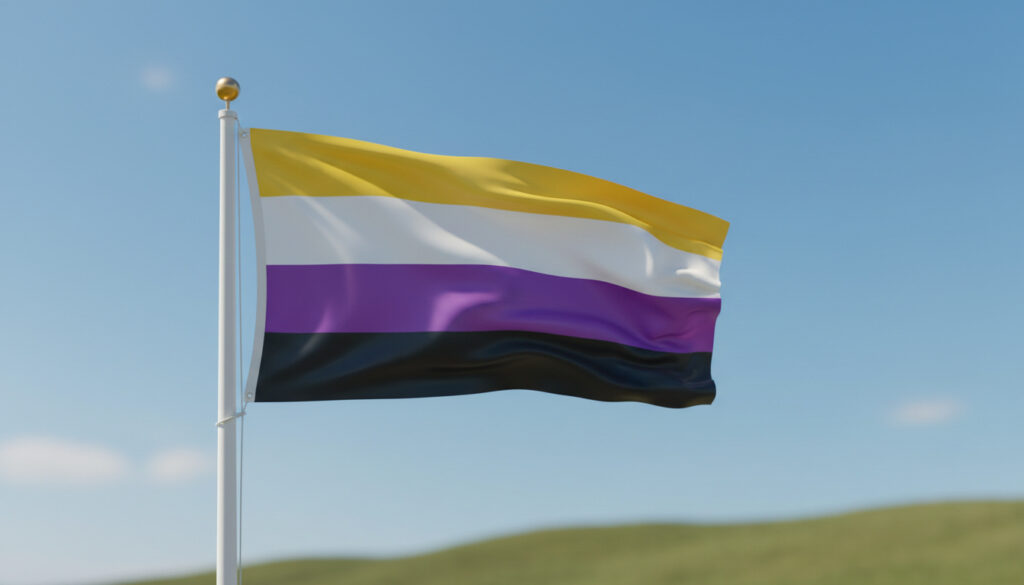
Yellow, white, purple, and black flag stripes
Approximately 52% of trans respondents in UK surveys
- Recognized as valid by APA, WHO, and ICD-11 medical standards
- Distinct from sexual orientation; describes identity rather than attraction
- Increasing legal recognition with “X” markers available in 20+ countries
- Represents internal experience requiring no medical intervention
- Encompasses specific identities including agender and bigender
- Separate from biological sex assigned at birth
| Aspect | Details |
|---|---|
| Core Definition | Gender identity not exclusively male or female |
| Umbrella Coverage | Agender, genderqueer, genderfluid, bigender, neutrois, demiboy |
| Term Origin | Early 2000s, roots in 1990s genderqueer theory |
| Population Data | ~20% of trans populations in broader literature; 52% in UK-specific data |
| Recognition Status | Formal acknowledgment in ICD-11 and major psychological guidelines |
| Legal Options | “X” markers available in UK, Canada, Australia, Germany, parts of US |
What Pronouns Do Non-Binary People Use?
Singular “they/them” serves as the most commonly associated pronoun set for non-binary individuals, though preferences vary widely based on personal comfort and context. According to Rider University’s LGBTQIA Center, these neutral pronouns function as grammatical singular references similar to how “you” works for both individuals and groups.
Singular Usage and Variations
While they/them represents the most widely recognized option, some non-binary people use neopronouns such as ze/zir or xe/xem. Others may use multiple pronoun sets interchangeably or prefer specific binary pronouns (he or she) while maintaining non-binary identity. The singular usage of “they” has existed in English for centuries, though its specific application as a non-binary pronoun has formalized in recent decades.
When someone shares their pronouns, using them consistently demonstrates respect. Many non-binary individuals include pronouns in professional signatures or social media bios to clarify their identities.
Flexibility Over Time
Pronoun preferences may shift as individuals explore their identities. Some non-binary people feel comfortable with multiple pronoun sets, while others maintain strict preferences. This fluidity mirrors the broader nature of gender identity as potentially dynamic rather than static.
How Do You Know If You Are Non-Binary?
Recognition emerges from internal experience rather than external validation or medical criteria. Individuals typically arrive at this understanding when binary gender labels feel incomplete, inaccurate, or uncomfortable for describing their sense of self.
Internal Recognition
The process involves examining whether traditional gender categories align with personal experience. According to Minus18, this manifests as dissonance when referred to with gendered language or discomfort with expectations tied to assigned sex at birth. Some describe feeling like both genders, neither gender, or something entirely distinct from the binary framework.
No Universal Test
No clinical test or diagnostic requirement exists for non-binary identity. The American Psychological Association and World Health Organization recognize self-identification as sufficient validation. Individuals determine alignment through introspection, often exploring various labels before finding resonance with non-binary terminology or related identities like agender or genderfluid.
Is Non-Binary the Same as Gender Fluid?
While related, these terms occupy different positions within gender discourse. Non-binary functions as a broad umbrella category, whereas genderqueer, genderfluid, agender, and demiboy represent specific manifestations under this umbrella.
Genderqueer and Political Context
Genderqueer predates “non-binary” as terminology and often carries more explicit political connotations regarding gender norms, according to research published in PubMed Central. Today, significant overlap exists between the terms, with some individuals using them interchangeably while others maintain distinctions based on historical significance or personal resonance.
Agender (no gender), genderfluid (shifting identity), and demiboy (partially male-aligned) all fall under the non-binary umbrella, yet each describes specific experiences that differ from the broader definition.
Genderfluid Specificity
Genderfluid individuals experience shifts in their gender identity over time or across contexts. While all genderfluid people fall under the non-binary umbrella, not all non-binary people experience gender fluidly. Some maintain consistent identities that simply exist outside the binary, while others experience their gender as static but neutral or mixed.
Non-binary identity is neither a phase nor a homogeneous third gender. It encompasses static, fluid, multiple, and absent gender experiences that vary significantly between individuals.
Agender and Absence
Agender individuals report experiencing no gender identity whatsoever, distinguishing their experience from other non-binary identities that may involve strong but non-binary gender feelings. According to Bloom for All, this represents a complete absence rather than a position on the spectrum between male and female.
What Is the History of Non-Binary Identity?
-
Early transgender activists including Leslie Feinberg and Kate Bornstein challenged binary definitions through concepts of “gender outlaws,” highlighting identities beyond man/woman categories.
-
The term “genderqueer” emerged in online communities and academic discourse to describe non-conforming identities, with scholarly work by Monro (2005) describing mixtures or absences of gender.
-
“Non-binary” gained traction as distinct terminology, particularly in UK and US LGBTQ communities. Wikipedia notes this period saw increased mainstream visibility through social media and cultural representation.
-
A UK survey of 14,320 trans respondents found approximately 52% identified as non-binary, providing the first large-scale prevalence data for this population.
-
ICD-11 formally de-pathologized non-binary gender identities, reflecting international medical consensus and shifting from pathologizing to affirming models of care.
What Is Established vs. Unclear About Non-Binary Identity?
- Recognized by APA, WHO, and ICD-11 as valid identity category
- Self-identification constitutes sufficient validation
- Distinct from sexual orientation and biological sex
- Associated with higher rates of minority stress and mental health disparities
- Encompasses multiple specific identities under one umbrella
- Exact population prevalence varies significantly between surveys
- Specific biological or genetic markers remain unidentified
- Optimal healthcare protocols continue evolving
- Long-term outcomes of various transition pathways require further study
How Does Non-Binary Identity Fit in Global Culture?
Western discourse dominates contemporary non-binary visibility, yet similar concepts appear across cultures worldwide. South Asian hijra communities, Indigenous North American two-spirit traditions, and various third-gender categories in Pacific and African societies demonstrate historical precedence for gender recognition beyond binary systems.
Prevalence data currently skews toward urban, Western populations likely due to measurement availability rather than actual distribution. The World Health Organization frames gender as a spectrum influenced by biological, social, and genetic factors, acknowledging that binary classification represents a cultural construct rather than universal truth. Intersex distinctions remain important—non-binary identity refers to gender experience, not congenital biological variation.
What Do Leading Organizations Say About Non-Binary Identity?
Non-binary people may identify as having a gender that blends elements of being a man or a woman, or a gender that is different from either.
Gender identity exists on a spectrum, and non-binary identities represent valid positions within that range, requiring affirmative clinical approaches and legal recognition.
What Is the Core Meaning of Non-Binary Identity?
Non-binary meaning centers on gender identity that transcends the traditional male/female framework. As recognition grows through medical validation, legal protections, and cultural visibility, the term continues serving those for whom gender binary classifications prove insufficient. Whether experienced as fluid absence, multiple presences, or neutral positions, these identities reflect the diversity of human gender experience.
Frequently Asked Questions
Can non-binary people transition?
Yes. Some pursue gender-affirming care including hormones or surgery to alleviate dysphoria, though rates of medical transition vary and are not required for valid identity.
What does non-binary look like?
There is no single appearance. Non-binary people may present masculinely, femininely, androgynously, or variably. Expression does not determine identity.
Are non-binary people transgender?
Many are, if their identity differs from assigned sex, though not all use this label. Self-identification determines appropriate terminology.
What are common non-binary symbols?
The non-binary pride flag features yellow, white, purple, and black stripes representing genders beyond and within the binary, plus marginalized trans people.
Is non-binary a new identity?
The terminology emerged in the 2000s, but the experiences parallel historical third-gender categories across cultures worldwide.
More related posts
 ABC Vote Compass: 2025 Quiz to Match Your Views
 Amy Winehouse: Death Cause, Final Days, and Untold Facts
 Pandora Charms Ireland: Buy Authentic Charms Online
 France President: Macron, Wife Age Gap, Term Limits & Sarkozy
 Best Rice Cooker: Top Zojirushi and Hamilton Beach Picks
 Pakistan vs Sri Lanka – Farhan Century Clinches 5-Run Win
 Sanae Takaichi: Japan’s First Female Prime Minister
 Mario and Luigi – Brothers, Games, History and Brothership
