Saint Peter: Apostle, First Pope, and Martyr – Life & Legacy
Saint Peter was the most prominent of Jesus’s apostles, yet the Gospels portray him as impulsive, fearful, and prone to failure. His transformation from a Galilean fisherman into the foundational leader of early Christianity—and the figure upon whom the Catholic Church bases its claim of papal authority—makes his story one of human weakness meeting profound restoration.
Full name: Simon Peter ·
Birthplace: Bethsaida, Galilee ·
Death: c. 64–68 AD, Rome ·
Feast day: June 29 (with Paul) ·
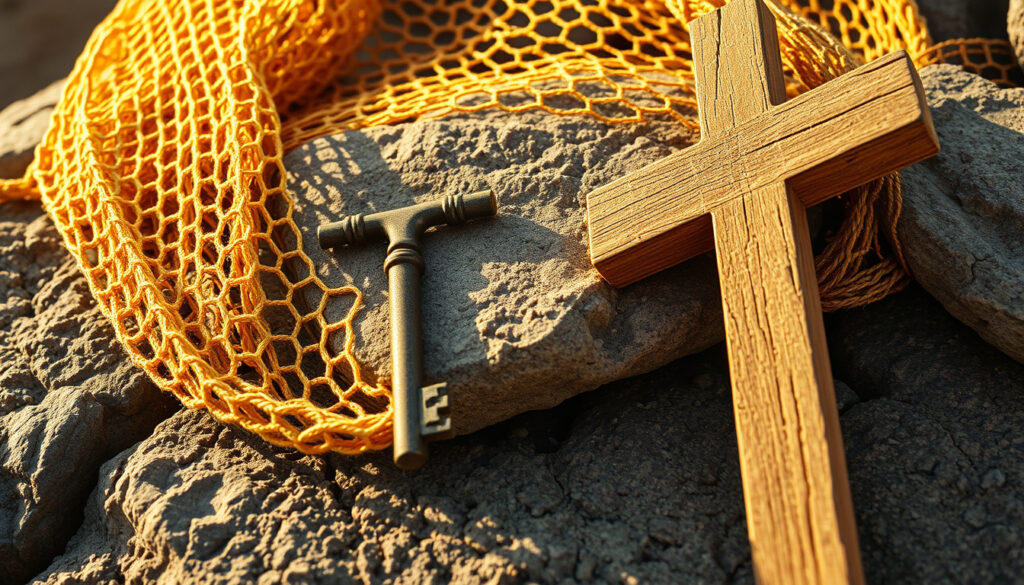
Symbol: Keys, inverted cross ·
Patron of: Fishermen, popes, the papacy
Quick snapshot
- Peter was one of the original apostles and a leading disciple in the New Testament (Encyclopaedia Britannica (reference work)).
- He is traditionally regarded as the first bishop of Rome by the Catholic Church (Catholic Answers (apologetics ministry)).
- Peter denied Jesus three times before the crucifixion (Gospel accounts). (Encyclopaedia Britannica (reference work))
- His feast day is June 29, shared with Paul (Vatican News (Holy See media)).
- Exact date and location of his crucifixion.
- Whether his wife was martyred alongside him.
- Authenticity of his last words to his wife.
- Precise details of his missionary journeys after Jerusalem.
- Born c. 1 BC–1 AD in Bethsaida, Galilee.
- Called by Jesus c. 27–29 AD.
- Denied Jesus c. 33 AD.
- Martyred c. 64–68 AD in Rome.
- Ongoing archaeological research under St. Peter’s Basilica.
- Continued debates among historians about the development of the papacy.
- Growing interest in Peter’s psychological profile among modern readers.
Seven key facts about Saint Peter, ranging from his name to his role in church tradition, reveal a man who was both a foundation stone and a deeply human figure.
| Attribute | Detail |
|---|---|
| Full name | Simon Peter (also Cephas) |
| Born | Bethsaida, Galilee (~1st century BC) |
| Died | c. 64–68 AD, Rome, Italy |
| Cause of death | Crucifixion (upside down) |
| Feast day | June 29 (Feast of Saints Peter and Paul) |
| Symbols | Keys, rooster, inverted cross |
| Patronage | Fishermen, popes, Rome, against fever |
What is Saint Peter known for?
Role as an apostle and first pope
- Peter is known as one of the Twelve Apostles and the first pope of the Catholic Church (Catholic Answers (apologetics ministry)).
- He is credited with leading the early Christian community after Jesus’ ascension.
- His symbols include keys and an inverted cross.
Key miracles and teachings
- Peter preached on Pentecost, resulting in thousands of conversions (Acts 2).
- He healed a lame man at the Temple gate (Acts 3).
- He raised Tabitha from the dead in Joppa (Acts 9:36-42).
Legacy in Christian tradition
- The Catholic Church reveres Peter as the first bishop of Rome (Encyclopaedia Britannica (reference work)).
- His burial site is traditionally beneath St. Peter’s Basilica.
- Eastern Orthodox tradition also venerates Peter as the foremost apostle, though without papal jurisdiction (Greek Orthodox Archdiocese of America (Orthodox body)).
Why did Jesus pick St. Peter?
Peter’s faith and confession
- Jesus declared Peter the ‘rock’ on which He would build His church (Matthew 16:18).
- Matthew 16:18 is central to later Catholic claims about Petrine authority (Vatican (Holy See doctrinal archive)).
- Peter was among the first disciples called (Matthew 4:18-20).
Symbolic name change (Rock)
- Jesus renames Simon as Peter in the Gospel tradition, linking his name to the image of a rock (Bible Gateway (scripture reference)).
- The name “Peter” derives from the Greek “Petros,” meaning rock or stone.
Leadership qualities
- Despite his flaws, Peter showed deep devotion and repentance.
- Peter acted as spokesman for the apostles at key moments (Acts 2).
- Paul’s letters mention Peter, showing his prominence in the earliest Christian movement (Bible Gateway (scripture reference)).
Jesus chose a man who would deny him three times — not despite his flaws, but because his repentance made him a shepherd who understood failure.
The pattern: Jesus’s choice of Peter reveals that leadership in the early church was built on transformed weakness, not flawless strength.
What sin did Peter struggle with?
Denial of Jesus three times
- Peter denied knowing Jesus three times before the rooster crowed (Luke 22:54-62).
- He struggled with fear and human weakness.
- His repentance was genuine and later strengthened his leadership.
Impetuous nature and fear
- Peter often spoke or acted impulsively, such as cutting off the ear of Malchus (John 18:10).
- He sank while walking on water due to fear (Matthew 14:29-31).
- Paul recounts confronting Peter in Antioch over his withdrawal from Gentile believers (Bible Gateway (scripture reference)).
Learning humility through failure
- The Gospels present Peter’s failures as part of a redemptive arc.
- After the resurrection, Jesus specifically reinstates Peter (John 21:15-19).
- Peter’s humility is reflected in his epistle: “Be shepherds of God’s flock” (Bible Gateway (scripture reference)).
Why was St Peter crucified?
Persecution under Emperor Nero
- Peter was martyred in Rome during Nero’s persecution (c. 64-68 AD).
- The earliest surviving account linking Peter’s martyrdom in Rome is often connected to 1 Clement, written in the late first century (New Advent (patristics archive)).
- Tertullian also refers to Peter’s death in Rome as martyrdom (New Advent (patristics archive)).
Crucifixion upside down
- Peter requested crucifixion upside down, deeming himself unworthy to die like Jesus.
- Eusebius reports Origen’s statement about the upside-down crucifixion (New Advent (patristics archive)).
- This detail is a later tradition, not stated in the canonical New Testament (Encyclopaedia Britannica (reference work)).
Martyrdom and burial
- His remains are traditionally believed to be beneath St. Peter’s Basilica.
- Irenaeus later argued for the Roman church’s apostolic succession through Peter and Paul (New Advent (patristics archive)).
- The Vatican built the basilica over the traditional burial site, with archaeological excavations in the 1940s revealing a first-century tomb.
The upside-down crucifixion detail is one of Christianity’s most vivid images, but it rests on later church tradition — not the biblical record itself. Readers should distinguish between historically secure facts and devotional traditions.
The implication: Peter’s martyrdom gave the Roman church a foundational story that linked its authority directly to an apostle who died for his faith.
What were Peter’s last words to his wife?
Tradition of Peter’s wife
- Early Church traditions mention Peter’s wife (1 Corinthians 9:5).
- Paul’s letter asks: “Don’t we have the right to take a believing wife along with us, as do the other apostles…?”
- No canonical record of his last words to her exists.
Last recorded words according to apocryphal texts
- Some apocryphal accounts record him telling her to ‘remember the Lord’ as she was led to martyrdom.
- The “Acts of Peter” is a second-century apocryphal text that includes this tradition.
- These writings are not considered canonical by any major Christian denomination.
Significance of family in early church
- The question of Peter’s marriage touches on broader debates about clerical celibacy in Catholic tradition.
- Eastern Orthodox churches allow married priests, citing apostles like Peter as precedents.
- Peter’s family life remains largely undocumented in the New Testament.
Timeline of Saint Peter’s life
The dates from Peter’s birth to his apostolic call are approximate — the New Testament provides narrative sequence, not precise chronology.
| Date | Event |
|---|---|
| c. 1 BC – 1 AD | Born as Simon in Bethsaida. |
| c. 27–29 AD | Called by Jesus to be a disciple (Bible Gateway (scripture reference)). |
| c. 30 AD | Confession at Caesarea Philippi; Jesus names him Peter (Bible Gateway (scripture reference)). |
| c. 33 AD | Denies Jesus three times; later repents. |
| c. 33–44 AD | Leads early church in Jerusalem; preaches on Pentecost (Bible Gateway (scripture reference)). |
| c. 44–67 AD | Travels to Antioch, Rome; writes epistles (1 & 2 Peter). |
| c. 64–68 AD | Martyred by crucifixion upside down in Rome. |
| c. 1600+ | St. Peter’s Basilica built over his traditional burial site. |
For readers comparing Peter’s timeline with Paul’s, the key overlap is the mid-1st century. The New Testament records their meeting in Jerusalem and later conflict in Antioch, showing that both figures were active simultaneously.
Confirmed facts vs. what remains unclear
Six confirmed facts about Peter are widely accepted by historians, while four points remain uncertain due to limited sources.
Confirmed facts
- Peter was a historical apostle of Jesus.
- He was martyred in Rome under Nero.
- He denied Jesus three times (Gospel accounts).
- The Catholic Church reveres him as the first pope (Encyclopaedia Britannica (reference work on papacy)).
- He was present at the Transfiguration and the Last Supper.
- Paul met him in Jerusalem (Bible Gateway (scripture reference)).
What remains unclear
- Exact date and location of his crucifixion.
- Whether his wife was martyred with him.
- Authenticity of his last words to his wife.
- Precise details of his missionary journeys after Jerusalem.
“And I tell you, you are Peter, and on this rock I will build my church.”
— Jesus (Matthew 16:18) (Bible Gateway (scripture reference))
“Be shepherds of God’s flock that is under your care… not lording it over those entrusted to you, but being examples to the flock.”
— Peter (1 Peter 5:2-3) (Bible Gateway (scripture reference))
“Peter was crucified head downward, having requested so because he felt unworthy to die in the same manner as his Lord.”
— Early Church tradition, recorded by Eusebius (New Advent (patristics archive))
For modern readers drawn to the story of Saint Peter, the implication is clear: a flawed human being became the foundation of an institution that has lasted two thousand years. Peter’s legacy is not in perfection, but in honest failure and sincere restoration.
facebook.com, seanmcdowell.org, catholic.com, en.wikipedia.org, ehrmanblog.org, focus.org, reddit.com, youtube.com, artsci.washu.edu, st-peters-basilica-tickets.com, reddit.com, christianhistoryinstitute.org
Frequently asked questions
Was Saint Peter married?
Yes, early Church traditions mention Peter’s wife (1 Corinthians 9:5). Paul’s letter implies that Peter traveled with his wife as other apostles did (Bible Gateway (scripture reference)).
What is Saint Peter’s symbol?
Peter’s primary symbols are keys (representing the keys of the kingdom given by Jesus) and an inverted cross (representing his crucifixion upside down). The rooster also symbolizes his denial of Jesus.
How did Saint Peter become pope?
The Catholic Church holds that Jesus appointed Peter as the head of the apostles in Matthew 16:18-19, giving him the “keys of the kingdom.” Peter’s role as first bishop of Rome developed into what is now called the papacy (Catholic Answers (apologetics ministry)).
What did Jesus say to Peter after the resurrection?
In John 21:15-19, Jesus asks Peter three times, “Do you love me?” and instructs him to “Feed my sheep.” This passage is seen as Peter’s reinstatement after his triple denial.
Why is Saint Peter considered the first pope?
Catholic tradition holds that Jesus gave Peter unique authority in Matthew 16:18-19, and that Peter exercised this authority as bishop of Rome, making him the first in a line of papal successors (Encyclopaedia Britannica (reference work on papacy)).
Where in the Bible does Peter walk on water?
Matthew 14:22-33 describes Peter walking on water toward Jesus before sinking due to fear. This story highlights both Peter’s faith and his human weakness.
What is the meaning of the name ‘Peter’?
The name Peter comes from the Greek “Petros,” meaning rock or stone. Jesus explicitly connects this meaning to Peter’s role as the foundation of the church (Matthew 16:18).
Related reading: Ruth Bader Ginsburg legacy · Tuesdays with Morrie summary
More related posts
 Melbourne Cup 2025 Winner: Half Yours & Jockey Suspension
 Tape Measure Complete Guide: Read & Use Phone Apps
 Aliens in the Attic: Hit or Flop? Cast & Streaming
 Asa Butterfield: Age, Relationships, Net Worth, Career
 Jane Seymour: Actress vs Queen – Biography, Family, Net Worth
 Ruth Bader Ginsburg: How She Built Gender Equality Into Law
 Martin Bryant: verified facts about the Port Arthur massacre
 Cast of 28 Years Later: Cillian Murphy Returns & Full Cast
