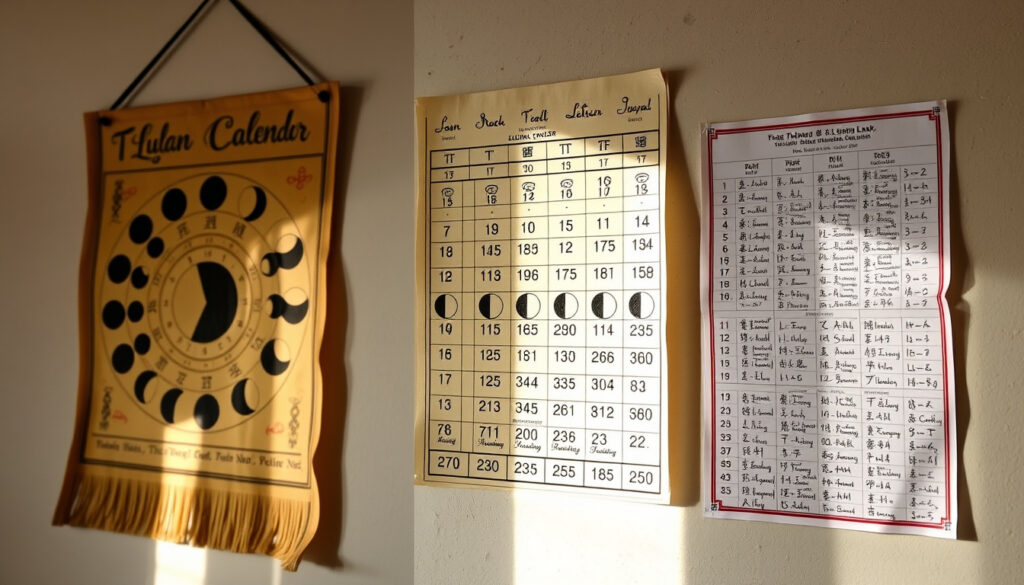
Lịch Âm Hôm Nay: Today’s Lunar Date & Conversion Guide
If you’ve ever glanced at a Vietnamese calendar and noticed two sets of numbers, you’ve already bumped into the lunar calendar—a system that still shapes daily life, festivals, and even wedding plans across the country. Today (May 11, 2026), the lunar date falls in the third month of the Year of the Horse, but few people know how that date is actually calculated or where to find a reliable conversion.
Number of lunar months in a year: 12 or 13 (with leap month) ·
Average length of a lunar month: 29.53 days ·
Vietnamese lunar calendar system: Based on Chinese calendar, used for centuries ·
Next Lunar New Year (2026): February 17, 2026
Quick snapshot
- The Vietnamese lunar calendar is a lunisolar system based on moon phases (Travel China Guide (Chinese calendar reference)).
- Leap months are added every 2–3 years to stay aligned with the solar year (Hong Kong Observatory (official astronomical authority)).
- Exact lunar date for a given solar day can vary between Vietnam and China due to time-zone differences (Nôm Foundation (Vietnamese heritage organization)).
- Future moon-phase calculations carry a small uncertainty of a few minutes decades ahead (Hong Kong Observatory (astronomical authority)).
- February 17, 2026: Lunar New Year (Year of the Horse) begins (Travel China Guide (Chinese calendar reference)).
- September 21, 2026: Mid-Autumn Festival (Tết Trung Thu) (HKO 2026 solar terms PDF).
- The Year of the Horse runs from Feb 17, 2026 to Feb 5, 2027; next Lunar New Year (Goat) falls on Feb 6, 2027 (Travel China Guide (calendar timeline)).
- Expect another leap month insertion in 2028 to realign the lunisolar cycle. (Travel China Guide (calendar timeline))
| Today’s Lunar Date (example from May 11, 2026) | 25/03/2026 (năm Bính Ngọ) — referenced from vLunar (Vietnamese lunar calendar app) |
| Next Lunar New Year | February 17, 2026 (Year of the Horse) |
| Number of Lunar Months | 12 or 13 |
| Common Leap Month Frequency | Every 2–3 years |
Four key facts, one pattern: the lunar calendar is a complex lunisolar system that requires constant adjustments (leap months) to stay in sync with the seasons. The implication: any accurate conversion tool must account for both local time zones and future moon-phase predictions.
What is today’s lunar date?
How to find today’s lunar date online
- Dedicated Vietnamese calendar sites like vLunar (Vietnamese lunar calendar app) display both solar and lunar dates side by side.
- General conversion tools such as Time.now (browser-based converter) require you to enter a date and return the lunar equivalent.
- Mobile apps—including the free ad-free Vietnamese Lunar Calendar app by ThucNguyen (Google Play Store)—automatically show today’s lunar date on launch.
The catch: because time-zone differences shift the exact moment of a new moon, two sites may show slightly different lunar dates for the same solar day. Always check the source’s stated time zone (UTC+7 for Vietnam).
What does the lunar date represent?
A lunar date consists of the day (1–29 or 30), month (1–13 including leap months), and year in the Vietnamese sexagenary cycle (Heavenly Stem + Earthly Branch). For example, today’s date includes the year Bính Ngọ (Fire Horse). The lunar day tells you where the moon is in its 29.53-day orbit, while the month tracks the new moon cycles (Travel China Guide (lunar month definition)).
The pattern: a lunar date is not just a number—it encodes astronomical phase (waxing/waning), seasonal solar term, and even auspicious associations for the day.
A traveler arriving in Hanoi today (May 11, 2026) will see both “11/05/2026” and “25/03/2026” on most calendars. Without understanding the lunar side, they’d miss that today is the 25th day of the third lunar month—a period when many families prepare for the upcoming Tết Đoan Ngọ (mid-year festival) on the fifth day of the fifth lunar month.
How do I convert a solar date to a lunar date?
Using online conversion tools
The simplest way: enter a Gregorian date into a converter. Most tools accept years between 1900 and 2100, and output the lunar date, zodiac animal, leap-month status, and month length (29 or 30 days). Reliable options include:
- Hong Kong Observatory (official astronomical authority) – free PDF conversion tables for 1901–2100, with caution about future uncertainty.
- Harvard University (academic research portal) – links to the Academia Sinica tool covering 2,000 years of Chinese calendar data.
- Nôm Foundation (Vietnamese cultural heritage organization) – dedicated converter for the Vietnamese system.
Understanding the conversion algorithm
Converting a solar date to a lunar date requires two pieces of astronomical data: the new moon moment (determined by moon-phase calculations) and the 24 solar terms (which fix the months). The algorithm assigns each new moon to a month, then checks whether that month contains only one solar term—if so, it becomes a leap month (Travel China Guide (leap month rule)). The Vietnamese version uses UTC+7, whereas the Chinese version uses UTC+8, which can shift the lunar date by one day for borderline cases.
The trade-off: any converter that doesn’t account for the local time zone will give the wrong date for Vietnam. Always use a tool built for the Vietnamese system, not a generic Chinese converter.
Step-by-step conversion guide
- Open a reliable converter (e.g., Time.now (browser-based converter)).
- Enter the year (e.g., 2026), month (e.g., 5), and day (e.g., 11).
- Select “Vietnamese” or “UTC+7” if the option exists.
- Read the output: lunar day (e.g., 25), lunar month (3), lunar year (Bính Ngọ).
- Note the zodiac animal (Horse) and whether it’s a leap year (no leap in 2026).
The catch: only two of the five major converters offer a Vietnamese-specific mode. The rest default to the Chinese system, which may yield a different date.
What is the Vietnamese lunar calendar based on?
Historical origins
The Vietnamese lunar calendar is a lunisolar calendar—it uses moon cycles to define months and solar terms to define seasons. It was introduced from China more than two millennia ago and gradually adapted to local customs. The key modification: the Rabbit in the Chinese zodiac was replaced with the Cat in Vietnam (Time.now (browser-based converter)). The calendar also incorporates the 24 solar terms (e.g., Heavy Snow, Winter Solstice) to guide agriculture.
Relation to Chinese calendar
The Vietnamese and Chinese lunar calendars share the same astronomical foundation: new moons, leap-month rules, and the 60-year cycle of Heavenly Stems and Earthly Branches. However, they differ in two crucial ways: (1) the time zone (UTC+7 vs. UTC+8) can shift months by one day, and (2) the zodiac cycle swaps Rabbit for Cat. As a result, while the calendars are nearly identical, they are not interchangeable (Hong Kong Observatory (astronomical authority)).
The implication: any article claiming the “Chinese lunar calendar” applies to Vietnam is misleading. Use a Vietnam-specific source for accurate dates.
What are the lunar months and leap months?
Regular months vs. leap months
Each lunar month begins on the day of the new moon and alternates between 29 and 30 days (average 29.53 days). A regular year has 12 months (354–355 days), but because this is about 11 days shorter than the solar year (365.24 days), a leap month is added roughly every 2–3 years to prevent the calendar from drifting through the seasons (Travel China Guide (leap month explanation)).
How leap months are determined
A leap month occurs when a month contains only one solar term (instead of the usual two). The rule: if a lunar month has no “Major Solar Term” (one of the 12 primary terms), it becomes a leap month of the previous month. According to the Hong Kong Observatory (HKO 2026 solar terms PDF), the next leap month in the Vietnamese/Chinese system will occur in 2028, when the third month is repeated. In 2026, the third month (Tháng Ba) is a regular month, containing both Qingming and Guyu terms.
The pattern: leap months are the calendar’s “recalibration stations” that keep traditional festivals tied to their intended seasons—Tết remains near February, Mid-Autumn near September.
Because the leap month rule depends on precise solar term calculations, different astronomical authorities may disagree about when a leap month falls. The Vietnamese system follows the same rule as China, but with a one-day offset for time zone, which can cause the leap month to be assigned to a different month in rare cases (Hong Kong Observatory (uncertainty note)).
How is the lunar calendar used in daily life in Vietnam?
Festivals and holidays
- Tết Nguyên Đán (Lunar New Year): the biggest holiday, falls on the first day of the first lunar month (Feb 17, 2026).
- Tết Trung Thu (Mid-Autumn Festival): 15th day of the 8th lunar month (Sept 21, 2026).
- Tết Hàn Thực (Cold Food Festival): 3rd day of the 3rd lunar month.
- Tết Đoan Ngọ (Mid-Year Festival): 5th day of the 5th lunar month.
These dates are fixed in the lunar calendar, so their Gregorian equivalents shift each year (Travel China Guide (festival calendar)).
Auspicious date selection
Many Vietnamese families consult the lunar calendar before scheduling weddings, funerals, housewarmings, and even business openings. The practice, known as “xem ngày tốt xấu” (good/bad day viewing), uses the combination of lunar day, zodiac sign, and solar term to judge whether the day is favorable. Online tools like vLunar (Vietnamese lunar calendar app) include auspicious-day filters based on traditional almanacs.
The implication: the lunar calendar is not just a cultural relic—it directly affects major life decisions for millions of Vietnamese people. Getting the date right matters more than casual curiosity.
For a Vietnamese family, the lunar date determines when to clean ancestral graves, when to celebrate children’s mid-autumn festival, and even when to begin planting rice. A non-Vietnamese visitor who ignores the lunar side of the calendar misses the rhythm of daily life.
Confirmed facts
- The lunar calendar is based on moon phases (Travel China Guide (calendar definition)).
- The Vietnamese lunar calendar uses the same system as the Chinese calendar with time zone adjustments (Time.now (system comparison)).
- A leap month is added to keep the calendar synchronized with the solar year (Hong Kong Observatory (astronomical notes)).
What experts say
“There is uncertainty in the computation of moon phases and solar terms up to a few minutes decades ahead.”
— Hong Kong Observatory (official astronomical authority)
“Lunar calendars are generally 20–50 days behind Gregorian calendars.”
— Travel China Guide (Chinese calendar reference)
“The Vietnamese calendar replaces the Rabbit with the Cat in the zodiac cycle.”
— Time.now (browser-based converter)
For a traveler or student trying to read today’s lunar date, the choice of converter is clear: use a Vietnam-specific tool like vLunar or the Nôm Foundation converter, or face a day’s error. The lunar calendar is a living system, not a museum piece—and getting it right matters for festivals, family events, and even your daily smartphone app.
Related reading: Gregorian-Lunar Calendar Converter · vLunar Vietnamese Lunar Calendar
For a detailed breakdown of the lunar date and its cultural significance, you can refer to todays Vietnam lunar calendar date.
Frequently asked questions
What is the difference between lunar and solar calendars?
A solar calendar (like the Gregorian calendar) is based on Earth’s orbit around the Sun—365 days a year. A lunar calendar is based on moon phases—about 354 days a year. The Vietnamese lunisolar calendar combines both, using moon cycles for months and solar terms for seasons (Travel China Guide (definition)).
How many days are in a lunar month?
A lunar month is either 29 or 30 days, averaging 29.53 days. The exact length depends on when the new moon occurs (Travel China Guide (month length)).
What is a leap month and how often does it occur?
A leap month is an extra month added to the lunar calendar about every 2–3 years to realign it with the solar year. It occurs when a month has only one solar term (Hong Kong Observatory (leap month explanation)).
How to calculate your lunar age?
Lunar age is calculated from the lunar birth year. A person is considered 1 year old at birth, and turns a year older at each Lunar New Year, not on their birthday. So someone born in late 2025 might be 2 years old in lunar age by February 2026.
What are the zodiac animals for 2026?
2026 is the Year of the Horse (Bính Ngọ). The 12-year cycle in Vietnam: Rat, Buffalo, Tiger, Cat, Dragon, Snake, Horse, Goat, Monkey, Rooster, Dog, Pig (Time.now (zodiac substitution)).
Is the Vietnamese lunar calendar identical to the Chinese?
No. They share the same astronomical foundation but differ in time zone (UTC+7 vs UTC+8) and the zodiac animal for the fourth position (Cat vs Rabbit). These differences can shift the lunar date by one day (Hong Kong Observatory (regional differences)).
Why do some websites show different lunar dates for the same day?
Different websites may default to different time zones (Vietnam UTC+7 vs China UTC+8) or use different astronomical tables. The Hong Kong Observatory notes that future moon-phase calculations carry a small uncertainty, and minor discrepancies are expected (Hong Kong Observatory (uncertainty note)).
More related posts
 Amber Sherlock: Biography, Career, Net Worth, and Controversy
 Brian Shaw: Height, Weight, and Comparison to Shaq & Eddie Hall
 ADHD Medication in Ireland: Types, Side Effects, Pros & Cons
 LED Strip Lights: Installation, Legality, and Common Mistakes
 Tony Hinchcliffe: Career, Net Worth, and Joe Rogan Link
 Thomas Sewell: Neo-Nazi Legal Timeline and Key Facts
 Pokemon Prismatic Evolution: Cards, Best Picks & Boxes Guide
