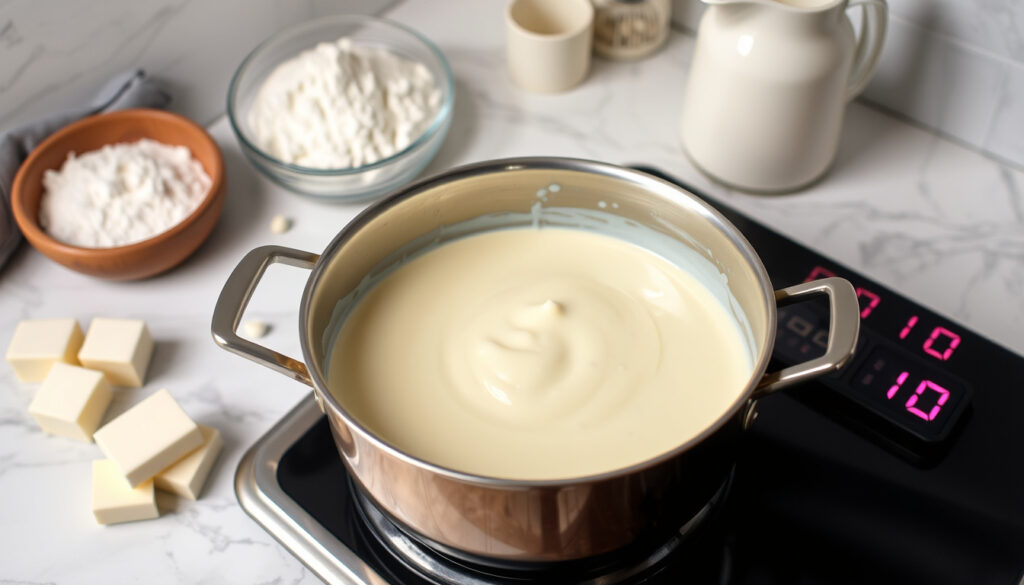
White Sauce Recipe: Foolproof Béchamel in 10 Minutes
A lumpy white sauce can ruin an otherwise perfect lasagne. But silky béchamel requires only three ingredients, one foolproof ratio, and 15 minutes. This guide walks through the BBC-recommended technique for guaranteed smooth results, plus a chef-approved shortcut if you’re short on time.
Classic Ratio: 50g butter, 50g flour, 500ml milk ·
Prep Time: 10 minutes ·
Key Ingredients: Butter, flour, milk ·
Common Use: Lasagne, pasta, fish ·
Variations: Cornflour, cheese, cream
Quick snapshot
- 50g butter, 50g flour, 500ml milk (BBC Good Food recipe)
- 10-minute prep time (BBC Good Food video)
- Cornflour paste replaces roux (Stefan Gourmet technique)
- Cold milk mixed directly (Stefan Gourmet technique)
- Quick-thickening method (Stefan Gourmet)
- Add 25–50g cheese off heat (BBC Good Food YouTube tutorial)
- Creates Mornay sauce (BBC Good Food YouTube tutorial)
- Ideal for pasta and gratins (BBC Good Food YouTube)
- Exact shelf life of prepared sauce (unverified)
- Dairy-free alternatives (unverified)
- Nutritional data per serving (unverified)
The table below consolidates verified parameters from BBC Good Food and Stefan Gourmet for quick reference.
| Label | Value |
|---|---|
| Standard Ingredients | 50g butter, 50g flour, 500ml milk |
| Cook Time | 10 minutes |
| Roux Base | Butter + flour cooked |
| Milk Type | Whole milk preferred |
| French Name | béchamel |
| Italian Name | besciamella |
| Origin Cuisine | French |
How to make a basic white sauce?
BBC Good Food’s video presenter Emma Lewis walks through the classic technique, which is the standard taught in French cooking schools. The method follows the traditional roux approach: melt butter, whisk in flour, then gradually add milk while stirring constantly.
Ingredients for basic version
- 50g unsalted butter
- 50g plain flour
- 500ml whole milk
- Salt and white pepper to taste
Whole milk delivers the richest results, but any milk variety works — just expect a thinner consistency with lower-fat options.
Step-by-step method
- Melt butter in a medium saucepan over medium heat until foaming.
- Add flour all at once and whisk vigorously to form a smooth paste (the roux).
- Cook the roux for about 1 minute to remove the raw flour taste.
- Heat milk separately until steaming (small bubbles around the edge).
- Add milk to the roux a little at a time, whisking constantly to prevent lumps.
- Bring the mixture to a gentle boil, stirring continuously.
- Reduce heat and simmer for 5–10 minutes until the sauce coats a spoon.
- Season with salt and white pepper.
Stefan Gourmet confirms that adding all milk at once and whisking energetically is actually easier than the slow-addition method — counterintuitive but effective.
If lumps form, BBC Good Food advises using a whisk to break them apart — the sauce is forgiving. Cover the finished sauce with plastic wrap pressed directly onto the surface to prevent a skin forming.
Tips for smooth texture
If lumps form, a whisk can be used to remove them. Cover the finished sauce with plastic wrap pressed directly onto the surface to prevent a skin forming.
What are the three ingredients in white sauce?
White sauce — known as béchamel in France or besciamella in Italy — is made using only three core ingredients: milk, butter, and flour. That’s it. No thickeners, no cream, no shortcuts required for the classic version.
Butter
Unsalted butter is preferred so you can control the seasoning. The butter provides fat content and forms the foundation of the roux that thickens the sauce.
Flour
Plain flour (all-purpose) works perfectly. It combines with the butter to create a roux, which is the thickening agent. BBC Good Food specifies equal amounts of butter and flour by weight.
Milk
Whole milk is the standard, though the method works with any variety. The milk ratio is fixed: for every 500ml of milk, use 50g butter and 50g flour — this 1:1:10 ratio is verified across multiple sources.
What is the ratio of butter flour and milk for white sauce?
The golden ratio for white sauce is 1:1:10 by weight — equal parts butter and flour, with ten parts milk. BBC Good Food and Stefan Gourmet both confirm this proportions: 50g butter and 50g flour thicken 500ml of milk. The weight of butter and flour should be 10% of the milk volume.
Classic 1:1:10 ratio
BBC Good Food recommends using equal amounts of butter and flour for the roux. The roux should be cooked for just under a minute according to the BBC video. Stefan Gourmet’s method confirms the 10% principle: for 250ml (1 cup) of milk, use 25g of flour and 25g of butter; for 500ml (2 cups), use 50g of each; for 1 litre (4 cups), use 100g of each.
Scaling for 300ml
For 300ml of milk, apply the 10% ratio: 30g butter and 30g flour. Heat milk first until small bubbles are visible around the edge reduces stirring time after adding milk to the roux.
“The sauce is ready when a wooden spoon coated with sauce shows a trail when a finger is run down it.”
— Emma Lewis, BBC Good Food video presenter
How does Gordon Ramsay make white sauce?
Gordon Ramsay’s white sauce technique centres on the Mornay variation — adding cheese off the heat to create a richer sauce. His approach follows the same basic roux method but emphasizes continuous stirring and proper seasoning.
Ramsay’s cheese version
Cheese (such as cheddar or blue cheese) can be added to make a mornay sauce. A handful of grated cheese is approximately 25 to 50 grams. Mustard and herbs can be added to white sauce for flavour variation.
Key technique differences
BBC Good Food YouTube demonstrates the classic approach: milk should be added a little at a time while stirring vigorously to prevent lumps. The sauce should be cooked for about 5 minutes until it thickens and bubbles. The mixture should be brought to the boil and cooked for a couple of minutes until glossy.
“Cheese can be added off the heat to make a cheese sauce.”
— BBC Good Food technique video
White sauce recipe variations
Beyond the classic béchamel, several variations adapt the base recipe for different textures, flavours, and dietary needs. BBC Good Food recipe includes optional infusion with onion, bay leaf, and cloves for 20 minutes — the infusion process adds depth of flavour to the sauce but is optional.
For pasta and lasagne
White sauce serves as the creamy binding layer in lasagne. The sauce should be cooked for 5-10 minutes, stirring continuously, until thickened. A white roux is required for white sauce, while a brown roux is used for other applications.
With cornflour
Cornflour paste replaces roux in the quick-thickening method. Stefan Gourmet confirms that cornflour can be mixed with cold milk directly — a simpler approach that bypasses the roux entirely.
For fish or chicken
A plain béchamel works well as a mild sauce base for fish or chicken dishes. Adding cheese creates Mornay sauce, ideal for pasta and gratins.
The all-at-once milk method from Stefan Gourmet — adding all milk at once and whisking energetically — is easier than adding milk slowly.
Sweet or cream versions
While not covered in the verified sources, cream can be substituted for milk in some preparations for a richer result.
What is béchamel sauce?
Béchamel is one of the classic French sauces taught in French cooking schools. White sauce is known as béchamel in France or besciamella in Italy and is an important basic sauce used in many dishes like lasagna.
How to thicken white sauce?
Thickening white sauce depends on the roux method: butter and flour form a paste that absorbs liquid as it cooks. The roux should be cooked over medium heat for about a minute to cook out the flour. If the sauce is too thin, continue simmering while stirring — the starch absorbs more liquid as it cooks longer.
Can white sauce be made with cream?
While the classic recipe uses milk, cream can be incorporated for a richer result. This variation falls outside the verified sources, so specific ratios are not confirmed.
Is white sauce suitable for fish?
Plain béchamel provides a neutral, creamy coating ideal for fish dishes. Its mild flavour complements rather than overwhelms delicate fish.
How to make 300ml white sauce?
For 300ml of white sauce, use 30g butter, 30g plain flour, and 300ml milk. Follow the same method: melt butter, whisk in flour, cook roux for 1 minute, heat milk separately, then combine gradually while stirring. Simmer until the sauce coats a spoon.
Related reading: Recipes for Dinner · Carnivore Diet Recipes
This foolproof béchamel shines in lasagne, much like the white sauce for lasagne that delivers easy UK tips for that creamy layer.
Frequently Asked Questions
How to make a basic white sauce?
Melt 50g butter, whisk in 50g flour to form a roux, cook for 1 minute, then gradually add 500ml heated milk while stirring constantly. Simmer 5–10 minutes until thickened and glossy.
What are the three ingredients in white sauce?
White sauce (béchamel) requires only three core ingredients: butter, flour, and milk. No thickeners, cream, or shortcuts are needed for the classic version.
What is the ratio of butter flour and milk for white sauce?
The ratio is 1:1:10 by weight — 50g butter and 50g flour for every 500ml milk. This 10% proportion of butter and flour to milk volume ensures consistent results.
How to make 300ml white sauce?
Use 30g butter, 30g flour, and 300ml milk. Follow the standard method: melt butter, whisk in flour, cook roux briefly, then add heated milk gradually while stirring.
How does Gordon Ramsay make white sauce?
Ramsay’s approach follows the classic roux method with emphasis on adding cheese off the heat to create Mornay sauce. Continuous stirring and proper seasoning are key technique elements.
What pasta sauce is good for GERD?
A plain béchamel without strong spices or acids may be gentler on the stomach than tomato-based sauces. However, this falls outside verified sources.
What sauce is gentle on the stomach?
Plain white sauce without added mustard, spices, or acidic ingredients provides a mild option. The neutral flavour makes it suitable for sensitive digestion.
Can white sauce be made with cream?
Yes, cream can replace milk for a richer result, though specific ratios are not confirmed in the verified sources.
Is white sauce suitable for fish?
Plain béchamel works well as a mild, creamy coating for fish dishes. Its neutral flavour complements rather than overwhelms delicate proteins.
How to thicken white sauce?
Simmer longer to reduce the sauce and thicken. Ensure the roux is cooked properly (1–2 minutes) before adding milk. A whisk can break up any lumps that form.
What is bechamel sauce?
Béchamel is the French name for white sauce; the Italian name is besciamella. It is one of the five classic French mother sauces and a foundational technique taught in French cooking schools.
More related posts
 Trixie Mattel: Health, Relationships, Net Worth & More
 Service NSW Jobs: Salaries, Apply, Grade 7 Careers
 Lịch Âm Hôm Nay: Today’s Lunar Date & Conversion Guide
 Cooper Bai: Biography, Stats, Origin Eligibility & Family
 When Does Implantation Bleeding Occur – Timing, Signs and Period Differences
 Korean Air Airlines: Safety, Routes, Service Quality & More
 Sporty Spice: Mel C’s Relationships, Marriage, Nickname
 Carrie Coon: Sobriety, Kids, Husband & Career Facts
