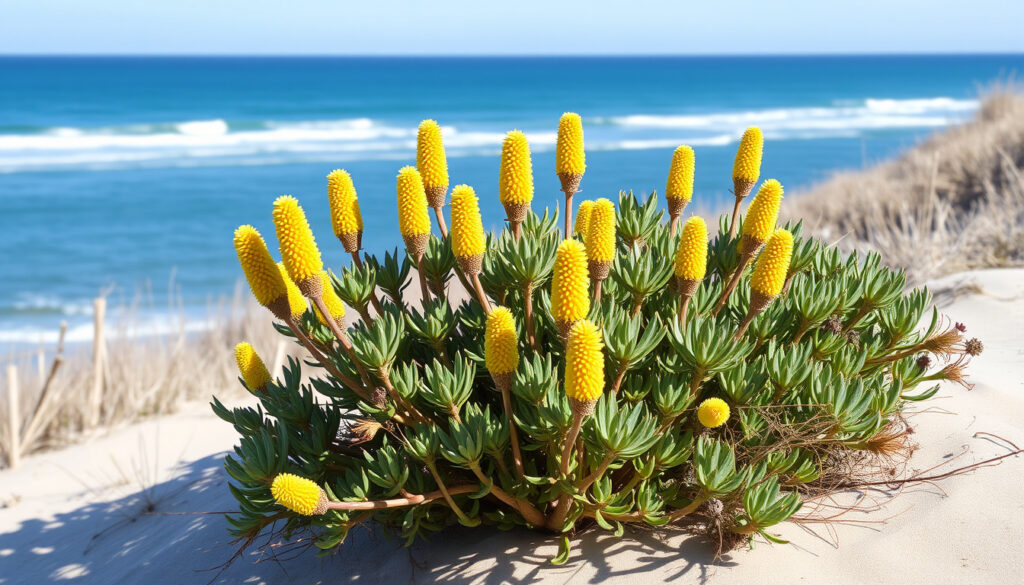
Banksia Integrifolia: Coastal Care & Planting Tips
If you live within sight of the ocean and have given up on finding a tree that doesn’t sulk in sandy soil, meet Banksia integrifolia. This Australian native handles salt spray, wind, and poor drainage with surprising ease, earning its reputation as one of the most forgiving coastal evergreens.
Mature height: 5–25 m (16–82 ft) · Growth habit: Tree or large shrub · Leaf color: Deep green above, white below · Flower color: Bright yellow spikes · Native region: Coastal eastern Australia · Bark: Tessellated or fissured
Quick snapshot
- Evergreen tree or large shrub – Gardenia (horticultural database)
- Narrowly elliptic leaves with serrated edges – Plant Lust (plant catalog)
- Deep green above, white below – Gardenia (horticultural database) (Gardenia (horticultural database))
- Bright yellow cylindrical flower spikes – Garden Express (Australian nursery)
- Bark rough and tessellated – Evergreen Trees Australia (specialist nursery)
- Full sun – Gardenia (horticultural database)
- Well-drained sandy soil – Evergreen Trees Australia (specialist nursery)
- Low water once established – Plant Lust (plant catalog)
- Frost sensitive if prolonged – Gardenia (horticultural database)
- Coastal gardens – Evergreen Trees Australia (specialist nursery)
- Parks and streetscapes – Gardenia (horticultural database)
- Windbreaks – Evergreen Trees Australia (specialist nursery)
- Wildlife gardens – Garden Express (Australian nursery)
- Exact lifespan in cultivation – not well documented
- Invasive root potential – Evergreen Trees Australia (specialist nursery) states roots are shallow and not invasive, but independent verification is limited
- Frost tolerance at lower temperatures – Gardenia (horticultural database) notes tolerance only in sharply drained soil
Six key characteristics define Banksia integrifolia at a glance.
| Attribute | Details |
|---|---|
| Height | 5–25 m |
| Native to | Coastal eastern Australia |
| Flower colour | Bright yellow |
| Leaf | Green above, white below |
| Bark | Tessellated or fissured |
| Growth rate | Slow |
| Soil pH preference | Slightly acidic, 6–6.5 (Garden Express (Australian nursery)) |
| USDA Zones | 9–11 (Gardenia (horticultural database)) |
| Salt tolerance | High (Plant Lust (plant catalog)) |
| Drought tolerance | High once established (Plant Lust (plant catalog)) |
“Full sun, fast drainage, deep establishment watering, and no high-phosphorus fertiliser are the non-negotiables for this species.” — Gardenia (horticultural database)
The implication: this tree is built for tough coastal sites, not for rich garden loam.
Where is the best place to plant a Banksia?
Best soil conditions
- Well-drained sandy soil is ideal – Gardenia (horticultural database) explicitly warns against soggy sites.
- Slightly acidic pH (6–6.5) is recommended by Garden Express (Australian nursery).
- Low-phosphorus fertiliser only – Garden Express (Australian nursery) advises slow-release, low-P formulas.
Sunlight requirements
- Select a spot with full sun. Gardenia (horticultural database) says light shade is tolerated only in hot inland gardens.
- Evergreen Trees Australia (specialist nursery) also insists on full sun for best performance.
Spacing considerations
- Common garden size: 30–40 ft tall, 15–30 ft wide – Gardenia (horticultural database).
- Evergreen Trees Australia (specialist nursery) describes roots as shallow and not invasive, but recommends avoiding planting directly against foundations.
The implication: site selection is the single most important decision — get it right and the tree handles the rest.
“Roots are shallow and not invasive, making Banksia integrifolia safe to plant near structures in most settings.” — Evergreen Trees Australia (specialist nursery)
How tall does Banksia integrifolia grow?
Height range
- Mature height 5–25 m (16–82 ft) depending on exposure – consistent across Gardenia (horticultural database), Plant Lust (plant catalog), and Evergreen Trees Australia (specialist nursery).
- Garden Express (Australian nursery) cites height over 25 m in ideal conditions.
Growth rate
- Growth is slow – Gardenia (horticultural database).
- Evergreen Trees Australia (specialist nursery) notes that in exposed coastal positions the tree stays shorter (shrub form) than in sheltered valleys.
Factors influencing size
- Can be pruned to maintain smaller size – Garden Express (Australian nursery) recommends pruning after flowering to encourage bushiness.
- Soil quality and water availability also affect final height.
- For those sourcing plants, local garden centres such as Flower Power Penrith may stock suitable dwarf cultivars.
The pattern: height is dictated more by exposure than by genetics — coastal winds keep it compact, sheltered valleys let it soar.
What are the benefits of Banksia integrifolia?
Ornamental value
- Striking yellow flower spikes bloom in autumn/winter – Gardenia (horticultural database) and Plant Lust (plant catalog) both highlight the floral display.
- Evergreen foliage provides year-round structure.
Wildlife attraction
- Attracts nectar-feeding birds and insects – Evergreen Trees Australia (specialist nursery) notes its role in supporting native fauna.
- Garden Express (Australian nursery) recommends it for wildlife gardens.
Low maintenance
- Hardy and adaptable to poor soils – multiple sources agree.
- Drought-tolerant once established – Plant Lust (plant catalog).
- No high-phosphorus fertiliser needed; low input.
Erosion control
- Useful as a windbreak or screen – Evergreen Trees Australia (specialist nursery) highlights its role in erosion control on coastal dunes.
“Coastal gardeners often face salty winds and sandy soil that kill most ornamentals. Banksia integrifolia turns those liabilities into assets.” — Plant Lust (plant catalog)
Coastal gardeners often face salty winds and sandy soil that kill most ornamentals. Banksia integrifolia turns those liabilities into assets: it uses the poor drainage and salt spray to outcompete less tolerant species, creating a low‑input evergreen screen that blooms when few other plants do.
The catch: the same toughness that makes it ideal for coasts means it can outgrow small spaces — plan for its full size from day one.
Confirmed facts vs what’s unclear
Confirmed facts
- Height range (5–25 m) from multiple sources – Gardenia (horticultural database), Plant Lust (plant catalog), Evergreen Trees Australia (specialist nursery)
- Native range – coastal eastern Australia
- Leaf and flower description – green above, white below, yellow spikes
- Best grown in full sun, well-drained soil – Gardenia (horticultural database), Evergreen Trees Australia (specialist nursery)
What’s unclear
- Exact lifespan – not documented in available sources
- Invasive root potential – Evergreen Trees Australia (specialist nursery) says shallow and non‑invasive, but independent data is sparse
- Frost tolerance at temperatures below −5°C – Gardenia (horticultural database) warns prolonged freezes are risky
- Salt and drought tolerance claims rely primarily on a single source, Plant Lust (plant catalog), with limited corroboration from independent trials
Most of the information on root behaviour and frost tolerance comes from nurseries, not independent botanical trials. Until peer‑reviewed data appears, treat the claims about non‑invasive roots as plausible but not proven.
The implication: rely on this species for coastal resilience, but treat specific claims about lifespan and root behaviour with healthy scepticism.
The evidence leaves little doubt: Banksia integrifolia is one of the most reliable coastal plants in cultivation. For the home gardener along the Australian east coast or in USDA zones 9–11, the choice is simple: give it sun, sand, and space, and it will reward you with decades of low‑maintenance greenery. For inland gardeners in colder climates, the trade‑off is slower growth and the risk of frost damage – a dwarf variety may be more sensible.
Frequently asked questions
How fast does Banksia integrifolia grow?
Slow. Gardenia (horticultural database) describes its growth rate as slow; it may take many years to reach 10 m.
Does Banksia integrifolia attract birds?
Yes. The large yellow flower spikes produce abundant nectar, attracting honeyeaters and other nectar‑feeding birds – Evergreen Trees Australia (specialist nursery).
What type of soil does Banksia integrifolia prefer?
Well‑drained, sandy, slightly acidic soil (pH 6–6.5). Gardenia (horticultural database) and Garden Express (Australian nursery) both stress fast drainage.
Can Banksia integrifolia be grown in a pot?
It is possible with a large container and very good drainage, but growth will be restricted. Dwarf or prostrate varieties are better suited.
Is Banksia integrifolia suitable for small gardens?
Only if pruned regularly or a compact cultivar is chosen. The species can reach 15 m in width – Gardenia (horticultural database) gives a typical spread of 15–30 ft (4.5–9 m).
What are the common varieties of Banksia integrifolia?
Notable cultivars include ‘Sentinel’ (compact form), a prostrate coastal form, and ‘Austraflora Pygmy Possum’ (low‑growing). Availability varies by region; check with Light Years Noosa for regional stockists.
More related posts
 Vicky Kaushal: Biography, Religion, Marriage to Katrina Kaif
 Medical Negligence Claim Ireland: Payouts, Proofs & Process
 Dyson Heppell: Retirement, Name Change, and New Coaching Role
 Maddison Inglis: Age, Height, Ranking, Engagement to Jason Kubler
 Will Sharpe: Japanese Heritage, Career, and Name Change
 Convert PDF to Excel: Free Methods, Tools, and Tips
 Diego Borella: Emily in Paris Assistant Director Dies at 47
 Big W Luggage: Complete Guide to Suitcases and Sets
