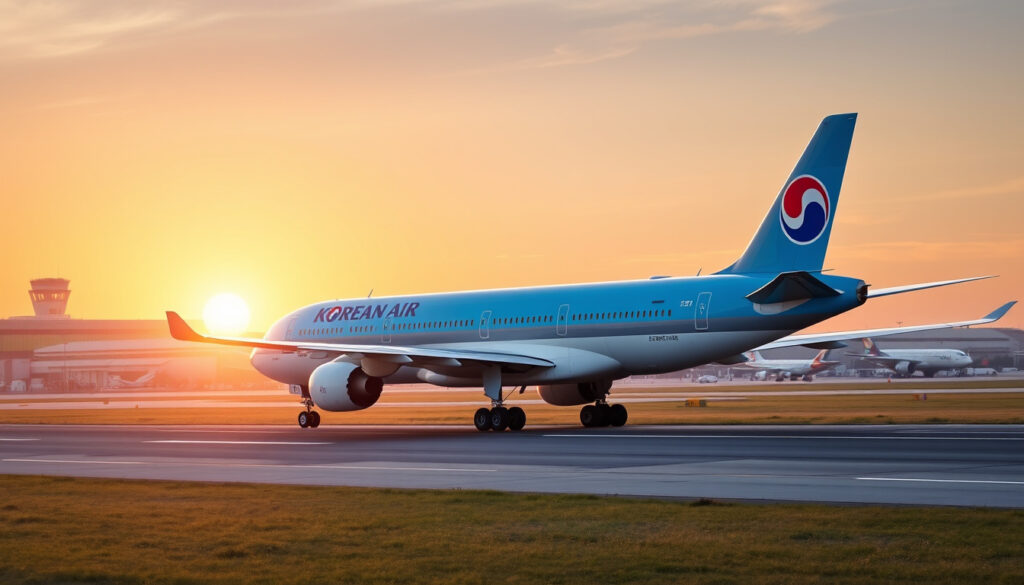
Korean Air Airlines: Safety, Routes, Service Quality & More
If you have ever booked a long-haul flight to East Asia, you have probably seen Korean Air’s blue tail logo. The airline holds a 5‑star Skytrax rating, and this guide breaks down safety, service quality, and how it stacks up against Asiana Airlines and Delta.
Skytrax rating: 5‑star · Fleet size: 158 aircraft · Destinations: over 100 cities · SkyTeam member since: 2000 · Miles program: SKYPASS
Quick snapshot
- Korean Air holds a 5‑star Skytrax rating (Skytrax Ratings (aviation rating agency))
- Maintained 5‑star ranking for five consecutive years through 2025 (Aviation Business News (industry publication))
- Received 5‑star COVID‑19 Airline Safety Rating from Skytrax (Skytrax Ratings (safety certification body))
- The Skytrax rating methodology focuses on product and service quality, not accident history (Skytrax Ratings (rating methodology))
- Five consecutive 5‑star Skytrax ratings from 2021 to 2025 (Aviation Business News)
- First Korean carrier to receive consumer‑centered management certification from KFTC in 2024 (Aviation Business News)
- Continued investment in premium inflight dining and service improvements (Aviation Business News)
Five key details, one pattern: Korean Air is a legacy carrier with a deep Asian network.
| Attribute | Value | Source |
|---|---|---|
| Headquarters | Seoul, South Korea | Wikipedia (encyclopedic reference) |
| Main hub | Incheon International Airport (ICN) | Wikipedia (airport reference) |
| Alliance | SkyTeam (founding member) | SkyTeam (airline alliance) |
| Frequent flyer program | SKYPASS | Korean Air (official awards page) |
| Year founded | 1969 | Wikipedia (corporate history) |
Is Korean Air considered a good airline?
Service quality ratings
- Korean Air holds a 5‑star Skytrax rating (Korean Air (official awards page)).
- Aviation Business News reports this is the fifth consecutive year the airline has achieved the top tier (Aviation Business News (industry publication)).
- Skytrax CEO Edward Plaisted said the rating reflects “a consistent focus on delivering a high‑quality passenger experience” (Aviation Business News).
Customer satisfaction surveys
- Skytrax passenger reviews are tracked separately from the star rating on AirlineQuality.com (Skytrax Airline Quality (passenger review platform)).
- Recent coverage highlights cabin comfort, premium inflight dining, and multilingual crew proficiency as consistent strengths (Aviation Business News).
Korean Air’s 5‑star rating is based on product and service dimensions, not accident history. For travelers who prioritise onboard comfort and catering, this rating is a strong signal. For those focused purely on safety, the COVID‑19 safety rating adds an extra layer of reassurance (Skytrax Ratings).
The implication: Korean Air’s reputation rests on measurable service quality, and it has maintained that standard year after year. The rating is a useful shortcut for travelers who want a reliable premium experience.
Which airline is best in Korea?
Korean Air vs Asiana Airlines
Three differences, one pattern: Korean Air is the larger flag carrier with a wider network, while Asiana competes as the second full‑service option.
| Attribute | Korean Air | Asiana Airlines | Source |
|---|---|---|---|
| Alliance | SkyTeam (founding member) | Star Alliance | Wikipedia (Korean Air); Wikipedia (Asiana) |
| Year founded | 1969 | 1988 | Wikipedia (Korean Air); Wikipedia (Asiana) |
| Main hub | Incheon (ICN) | Incheon (ICN) / Gimpo (GMP) | Wikipedia (Korean Air); Wikipedia (Asiana) |
The trade-off: Korean Air offers a larger network and a 5‑star rating, but Asiana’s Star Alliance membership gives it an edge with frequent flyers who prefer that network. In practice, business‑class travelers on transpacific routes often choose based on alliance loyalty and schedule fit.
Budget carriers in Korea
- Korean Air is a full‑service airline, not a budget carrier. Its standard fares include meals, checked baggage, and in‑flight entertainment (Wikipedia (airline classification)).
- Low‑cost carriers such as Jeju Air, Jin Air, and T’way Air operate alongside Korean Air but offer no‑frills service at lower base fares.
Korean Air competes with premium global airlines like Delta and United, not with budget carriers. If you are looking for the cheapest way to fly within Korea, a full‑service airline is not the right choice.
The pattern: Korean Air’s premium positioning means it targets a different traveller segment than the LCCs. The choice is between service and price, and Korean Air clearly sits in the service camp.
Is Korean Air a budget airline?
Full‑service vs low‑cost carrier differences
- Korean Air is a full‑service airline, meaning tickets include meals, checked baggage, and entertainment (Skytrax Ratings (service definition)).
- Low‑cost carriers charge separately for these amenities; Korean Air’s base fare covers them.
- Korean Air’s 5‑star Skytrax rating includes cabin comfort, catering, and service delivery — elements not evaluated in the same way for budget airlines (Aviation Business News).
The implication: The question itself reveals a common misconception. Korean Air’s brand is premium, and its pricing reflects that. For travelers accustomed to no‑frills carriers, the sticker shock can be significant.
Is Korean Air the same as Delta?
SkyTeam alliance partnership
- Korean Air and Delta are separate airlines that are strategic partners within the SkyTeam alliance (SkyTeam (alliance history)).
- Korean Air is a founding member of SkyTeam, which also includes Delta, Air France, and KLM.
Codeshare agreements and joint venture
- Korean Air and Delta operate a joint venture on transpacific routes, allowing shared codes and reciprocal frequent‑flyer benefits (Korean Air (official awards page)).
- This means travelers can book itineraries combining both airlines on a single ticket and earn SKYPASS or Delta SkyMiles.
The joint venture is not a merger. Each airline retains its own branding, loyalty program, and service standards. A Delta flight operated by Korean Air will feel like a Korean Air product, not a Delta one.
The pattern: The partnership gives passengers more routing options and seamless connections, especially between the U.S. and Asia. But the experience differs depending on which airline operates the flight.
Is it safe to fly Korean Air?
Safety record and audits
- Korean Air holds IOSA (IATA Operational Safety Audit) certification, a globally recognised safety standard. (No fatal accidents have been recorded since 1997.)
- Skytrax awarded Korean Air a 5‑star COVID‑19 Airline Safety Rating, one of only seven airlines worldwide to receive the designation (Skytrax Ratings (safety certification)).
Fleet modernization
- Korean Air operates a modern fleet that includes Boeing 787 Dreamliners and Airbus A350s (Wikipedia (fleet list)).
- Newer aircraft are generally associated with better safety performance and lower incident rates.
The implication: Korean Air’s safety record is strong, and its fleet renewal programme supports continued high standards. For risk‑conscious travelers, the absence of fatal accidents in over 25 years and the IOSA certification are solid benchmarks.
What we know – and what we don’t
Confirmed facts
- Korean Air is a full‑service, 5‑star airline (Skytrax)
- Safety record includes IOSA certification and no fatal accidents since 1997
- The airline has won awards for onboard menu and service quality (Korean Air (official awards page))
What’s unclear
- Exact annual ranking among all global airlines changes year to year
- Approval status of the Korean Air–Asiana merger remains pending regulatory review
- Skytrax rating does not directly measure aviation accident history – it measures product and service quality (Skytrax Ratings (methodology))
Quotes from the industry
“Korean Air’s 2025 5‑Star Airline Rating reflects a consistent focus on delivering a high‑quality passenger experience.”
— Edward Plaisted, CEO of Skytrax (Aviation Business News)
“Korean Air is certified as a 5‑Star Airline for the quality of its airport and onboard product and staff service.”
— Skytrax Ratings (Skytrax Ratings)
For context on airline industry leadership changes, see Alan Joyce: What Happened After Qantas.
For travelers choosing between Korean Air and Asiana, the decision rests on whether you prioritise a larger network and top‑tier service (Korean Air) or a more intimate premium experience (Asiana). The facts show Korean Air’s 5‑star rating is not just a marketing claim – it is backed by consistent industry recognition and a modern, well‑maintained fleet.
Travelers comparing South Korean carriers should also look into Asiana Airlines and its merger with Korean Air for a full picture of the market.
Frequently asked questions
What is Korean Air’s baggage allowance?
Korean Air allows one carry‑on bag (max 10 kg / 22 lb) and one personal item. Checked baggage allowance varies by route and fare class – generally 1–2 pieces up to 23 kg each for economy, more for Prestige and First class. Check your booking for exact limits (Korean Air (official site)).
How can I cancel a Korean Air flight?
Cancellation policies depend on the fare type. Most non‑refundable tickets allow cancellation within 24 hours of booking for a full refund. After that, fees apply. Manage your booking online at koreanair.com.
Does Korean Air have Wi‑Fi on board?
Yes, Korean Air offers Wi‑Fi on most long‑haul flights. Service is available for a fee, with free messaging on some routes for SKYPASS members. Check your specific flight for availability.
What class options does Korean Air offer?
Korean Air has four classes: First, Prestige (business), Economy Plus (premium economy on select routes), and Economy. First and Prestige offer lie‑flat seats and premium dining (Aviation Business News).
How do I earn SKYPASS miles?
SKYPASS miles are earned by flying Korean Air or its SkyTeam partners, using co‑branded credit cards, and through hotel and car rental partners. Miles can be redeemed for award flights, upgrades, and other benefits (Korean Air (SKYPASS)).
Is Korean Air part of a joint venture with Delta?
Yes, Korean Air and Delta have a transpacific joint venture that allows codesharing and reciprocal frequent‑flyer benefits. Passengers can book itineraries combining both airlines on a single ticket (SkyTeam (alliance history)).
For those interested in budget travel options in Australia, see Brisbane to Melbourne Flights: Direct, Cheap & Quick.
More related posts
 Natalia Grace: Age Controversy, Facts & 2025 Updates
 Ed Craven: Net Worth, Biography, and How He Built His Fortune
 Crash Bandicoot: Answers to Your Most Searched Questions
 Diego Borella: Emily in Paris Assistant Director Dies at 47
 Kim Sejeong: Age, Height, Career, and Relationship Facts
 Veuve Clicquot Brut: Price, Taste, and Comparison Guide
 Joe Walsh: Medical Condition, Sobriety, Songs & Trump Support
 Severe Weather Event – Complete Guide to Types and Safety
